


Bitcoin is consolidating around $70,000. The price has gone sideways. The capital flows beneath it have not.
Analyst Axel Adler has published data that reframes the current consolidation entirely: over the 30 days ending March 25, Bitcoin ETF funds absorbed 62,986 BTC in net inflows — $11.3 billion in institutional capital entering the market while the price moved from $64,100 to $71,307. That is not a market drifting. That is a market being quietly bought.
The acceleration signal sharpens the picture further. The 7-day flow average currently stands at 3,288 BTC per day against a 30-day average of 1,256 BTC — meaning institutional buying is running at 2.6 times its own monthly pace. ETF cumulative holdings have reached 1,326,874 BTC, a record that reflects the sustained, compounding nature of this demand rather than a single episodic event.

The counterweight is real and should not be minimized. Short-term holders are consistently realizing losses on exchanges — retail participants selling into weakness, adding distribution pressure that institutional inflows are currently absorbing and overcoming.
That is the structure of this market in one sentence: institutions are buying faster than retail is selling. At $70,000, the question is how long that equation holds.
Retail Is Selling Bitcoin at a Loss
Adler’s second dataset examines the other side of the market structure equation — and it is considerably less comfortable than the ETF picture. The Short-Term Holder P&L to Exchanges metric tracks how many BTC retail participants are sending to exchanges at a loss versus a profit over any 24-hour period. Right now, that reading stands at -15,500 BTC per day flowing to exchanges at a loss, against a total STH exchange inflow of 35,200 BTC per 24 hours.

The arithmetic is unambiguous: the majority of retail activity hitting exchanges is loss-realizing. This is not a temporary anomaly. Adler identifies it as a regime shift — a structural change in behavior that began at the local price peak and has not recovered above the neutral zone since. Short-term holders are not selling opportunistically. They are selling because they are underwater, and they have been for weeks.
What the data does not show is equally important. The -15,500 BTC daily loss flow is consistent with sustained stress, but it lacks the vertical spike that historically marks final capitulation — the exhaustion event where the last forced sellers leave the market simultaneously. That spike has not arrived.
The retail segment remains weak. The institutional segment remains active. The signal that resolves the tension between them is straightforward: loss-side sends compressing while price holds or rises. Until that compression appears, the stress regime remains intact.
The Weekly Chart Shows a Bull Market That Broke
Bitcoin is trading at $69,362 on the weekly timeframe, up 2.22% on a candle that opened at $67,859, reached $72,026, and has since retreated. That weekly high rejection at $72,000 — a level the market tested and failed to hold — is the operative technical fact. The candle is green. The rejection is real.
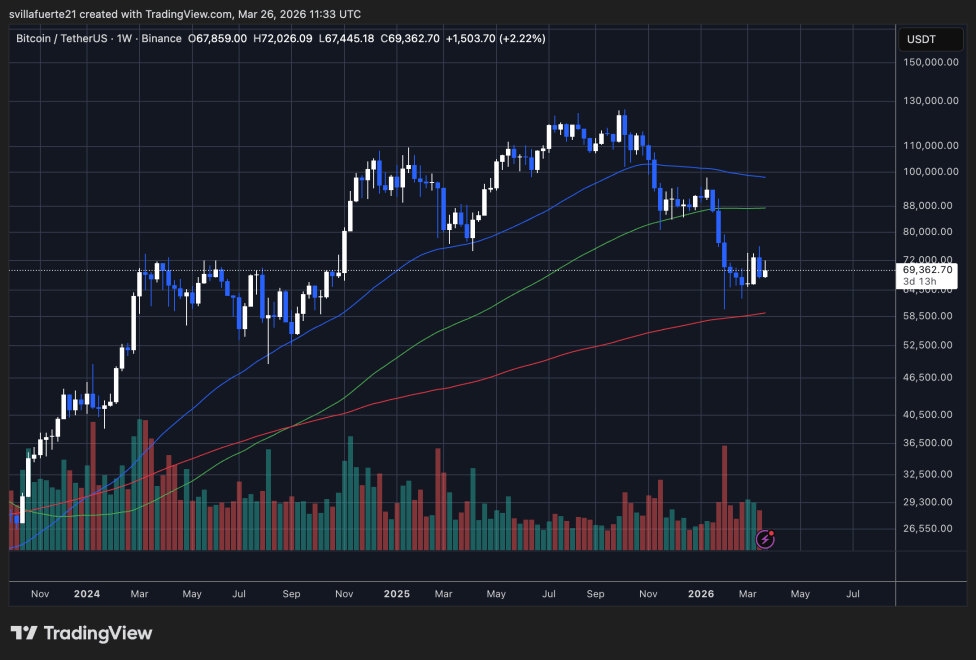
The macro context the weekly chart provides is essential. Bitcoin emerged from the 2023 base near $25,000, doubled through 2024, and peaked above $125,000 in late 2025 — a full cycle advance of roughly 400% from the breakout point. The current price at $69,362 represents a 45% drawdown from that peak, retracing the entire 2025 advance and returning to levels last seen in November 2024.
The moving average configuration tells the most important structural story. Price has broken below the 50-week MA — the blue line, now turning lower near $98,000 — and is currently testing the 100-week MA, the green line ascending through the $67,000–$68,000 region. That green line has provided definitive support at every major correction in this entire cycle. It held in 2024. It is being tested again now.
The 200-week MA, the long-term red line, continues its steady climb near $58,000 — deep support that has never been violated in Bitcoin’s post-2020 history.
This week’s low of $67,445 held the 100-week MA by the narrowest of margins. Whether it holds on a closing basis is the only question the weekly chart is currently asking.
Featured image from ChatGPT, chart from TradingView.com
The post $11.3 Billion Flows Into Bitcoin ETFs In One Month While Retail Sells At A Loss – Details appeared first on Bitcoinist.




Read More