

Back in 2011, Clifton Collins acquired 6,000 BTC. After his arrest in 2017, the coins were considered lost. Now, one of the addresses moved 500 BTC, raising questions about who managed to find or crack the private keys.
The known BTC wallets of Clifton Collins were idle for years, and the keys were considered lost or beyond reach. In the past day, Arkham Intelligence intercepted a single transaction that moved 500 BTC to a new address, which is now sitting idle. The funds are now valued at $35.5M, with over $426M held on all 12 addresses linked to Collins.
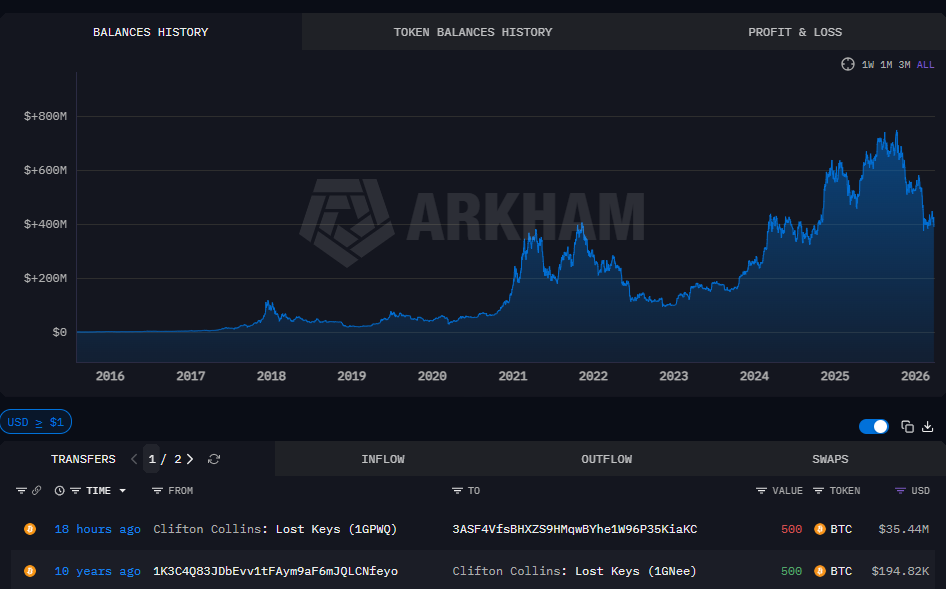
When Collins was arrested, his belongings were cleared out and thrown away, including the hidden private keys. Reportedly, the keys were written on paper and hidden in a fishing rod case.
It appears some of the keys may have been found, or maybe there was an alternative storage of the seed phrase.
How were the BTC keys discovered?
Any move of BTC from an old wallet raises multiple speculations. In the past months, BTC that was presumably lost started moving on multiple occasions, as even older whales decided to take profit.
In this case, there were multiple speculations on the discovery of one of the wallets linked to Collins. Since not all BTC were stored on the same address, most of the coins may remain idle. The coins were moved to a Coinbase Custody address, a move that has been used by law enforcement to safeguard seized assets.
Europol claimed they used advanced decryption to move the BTC
The movement of 500 BTC was not based on luck, but was a part of a law enforcement operation.
Europol reported that the wallets were, in fact, not lost but seized by the Irish police force. What was unusual is that the wallet was unlocked without access to the lost private keys.
While in general, BTC encryption is unfeasible to break, there are some exceptions. The wallet from 2011 may have been protected by a file, which was also accessible to law enforcement. The wallet may have been brute-forced to uncover another access point, such as a wallet.dat file.
“The Criminal Assets Bureau in collaboration with Europol gained access to and seized a cryptocurrency wallet containing 500 bitcoins, which are the proceeds of crime,” said the Irish Garda in a statement, without giving further details on the techniques used to access the wallet.
Another possibility is that Collins used a flawed key generation service with weaker randomization, allowing law enforcement to uncover the private keys. There was also the possibility that others were in possession of the private keys.
It is possible that the same methods may work on the remaining 11 wallets, where the keys were also derived in a similar fashion. A weaker key generation may produce more predictable outcomes, allowing reverse analysis to derive the private keys.
Europol is also in possession of additional BTC, some of it fully accessible and kept in storage. Some of the BTC came from the raid against Cryptomixer in December 2025.
If you’re reading this, you’re already ahead. Stay there with our newsletter.




Read More