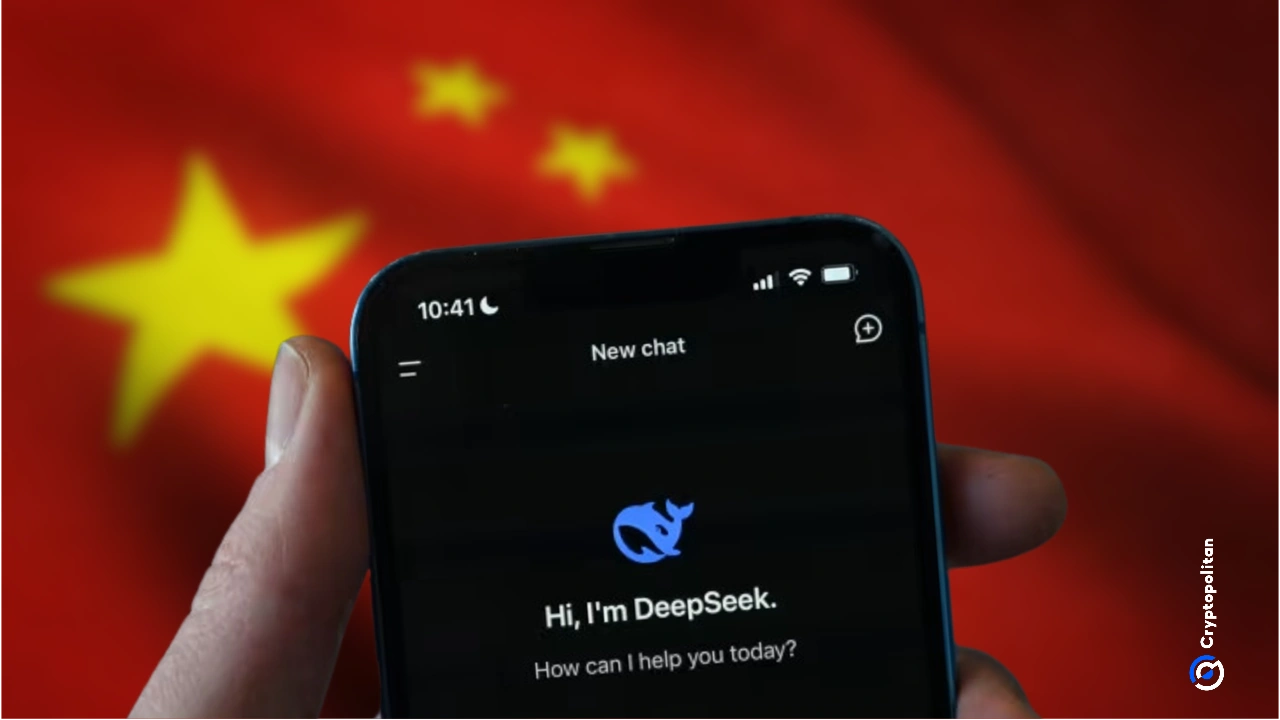


DeepSeek is hiring workers in Inner Mongolia for its late April launch, its first big release built to run on Huawei processors instead of American ones.
The firm also posted openings for server maintenance engineers and delivery managers in Ulanqab, a city in Inner Mongolia. The Hangzhou company hasn’t advertised on-site jobs for its computing infrastructure before.
The V4 set for late April uses a Mixture-of-Experts design with about 1 trillion parameters total, though just 32 to 37 billion work on any task. That keeps costs down as the model gets bigger.
“If they have successfully trained V4 entirely on Huawei silicon, it signals a material shift in the geopolitical tech landscape,” said Stephen Wu from Carthage Capital.
The release has been pushed back twice from February.
Silicon Valley rivals unite against Chinese firms
OpenAI, Anthropic, and Google said April 6 they’d share intelligence to stop Chinese companies from copying their models. The three competitors are working together through the Frontier Model Forum, an industry group from 2023.
Anthropic tracked 16 million exchanges from three Chinese firms across about 24,000 fake accounts. The companies allegedly used adversarial distillation, flooding ChatGPT and Claude with queries, then training their models on the responses.
OpenAI accused DeepSeek of copying its models “through new, obfuscated methods” in a February 12 memo to the House Select Committee on China.
The restrictions that started in 2022 to slow China’s AI development first led to chip output dropping 9.8% in 2022. However, those export controls on advanced chips seem to now be backfiring.
Domestic chips projected to reach 50% market share
Things are shifting. TrendForce projects domestic chips will reach 50% of China’s AI chip market in 2026. Chinese semiconductor equipment went from 25% to 35% of the home market between 2024 and 2025, beating the Made in China 2025 target of 30%.
China has put about $150 billion into chip development. The U.S. CHIPS and Science Act authorized $52.7 billion.
The switch to Huawei chips has not been without delays. As reported by Cryptopolitan previously, DeepSeek was expected to use banned Nvidia chips without revealing any technical signs.
Moving away from Nvidia takes “substantial re-engineering,” according to Wei Sun, principal AI analyst at Counterpoint Research. “That transition can slow development cycles and introduce performance trade-offs, especially for V4, a model expected to be state-of-the-art,” he said.
DeepSeek first gained prominence in January 2024 with R1, a reasoning model President Trump called a “wake-up call” for American companies. The company’s cheap tools are used widely in China and places like Southeast Asia and the Middle East.
If you’re reading this, you’re already ahead. Stay there with our newsletter.



Read More