

Hut 8 just announced its first-quarter 2026 earnings alongside a $9.8 billion AI data center agreement, sending its stock up nearly 32% today, May 6. CleanSpark, the fourth-largest public miner by Bitcoin holdings, has also been liquidating mined BTC at a blistering pace to fund operations amid record-low mining margins.
The two companies are the latest events in a wave of publicly traded miners redirecting capital from Bitcoin treasuries toward artificial intelligence infrastructure, a shift that produced record industry-wide BTC sales in the first three months of 2026.
Bitcoin miners dump a record 32,000 BTC in Q1
According to CryptoQuant data, public Bitcoin miners offloaded more than 32,000 BTC during Q1 2026, more than full-year 2025 net sales and even surpassing the approximately 20,000 BTC liquidated during the Terra-Luna collapse in Q2 2022.
The sellers included MARA Holdings, which sold 15,133 BTC for around $1.1 billion in March, and Riot Platforms, which made nearly $289.5 million from 3,778 BTC. Core Scientific also moved about 1,900 BTC (worth roughly $175 million) in January alone, according to the same report.
CleanSpark’s sales increased as the quarter went on. The firm sold approximately 159 of the 573 BTC it produced in January. By February, it had liquidated 553 of 568 BTC mined, nearly selling off all of its monthly production.
The selling wave represents a sharp reversal from 2024, when public miners added a net 17,593 BTC to their balance sheets and pushed combined treasuries past 100,000 BTC.
Why are miners selling BTC for AI data centers?
The Bitcoin sales are mostly driven by the difficulty in making profits from mining. Hashprice, which is a key measurement that tracks how much money miners stand to make, is currently near its lowest point ever, hovering in the low-$30-per-petahash-per-second range. Network difficulty is also roughly 10 times higher than it was in 2021, and the April 2024 halving reduced block rewards by half.
These factors are pushing miners toward AI workloads. According to industry data cited by Cryptopolitan in February, AI infrastructure can generate between three and 25 times more revenue per megawatt of power than traditional mining. As such, profit margins on AI workloads often reach 80% to 90%.
Hut 8’s data center agreement, valued at $9.8 billion, is one of the largest deals struck by a former pure-play miner. The company also recently refinanced a Bitcoin-backed credit facility, according to a May 1 statement.
It was Bitdeer who set the standard for the pivot earlier this year after it liquidated its entire Bitcoin treasury of more than 1,127 BTC to fund land acquisitions and high-performance computing expansion in February, per Cryptopolitan.
VanEck Head of Research Matt Sigel noted at the time that Bitdeer, “like other miners, is actively selling everything they mine (and more) to fund the AI pivot.”
Holdings are still large despite sales
Despite the record liquidations, public miners still hold significant Bitcoin collectively. Data from BitcoinTreasuries shows that 29 publicly traded mining companies hold a combined 100,287 BTC, worth approximately $8.19 billion at current prices.
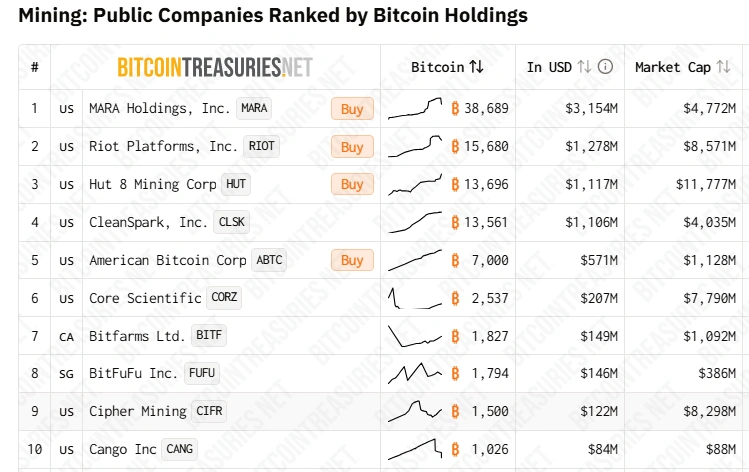
MARA leads the race with 38,689 BTC, followed by Riot Platforms at 15,680 BTC. Hut 8 holds 13,696 BTC, and CleanSpark holds 13,561 BTC, placing them third and fourth among public miners.
The question facing investors is whether Q1’s record selling was a one-time event or the start of a sustained downward trend. If hashprice stays low and Bitcoin fails to stabilize enough to offset compressed margins, the industry’s AI migration will likely continue till the end of 2026.
Your bank is using your money. You’re getting the scraps. Watch our free video on becoming your own bank


Read More