

Bettors on prediction markets are betting big that a significant cryptocurrency bill will become law this year, with a Senate committee due to vote on it in just a few days.
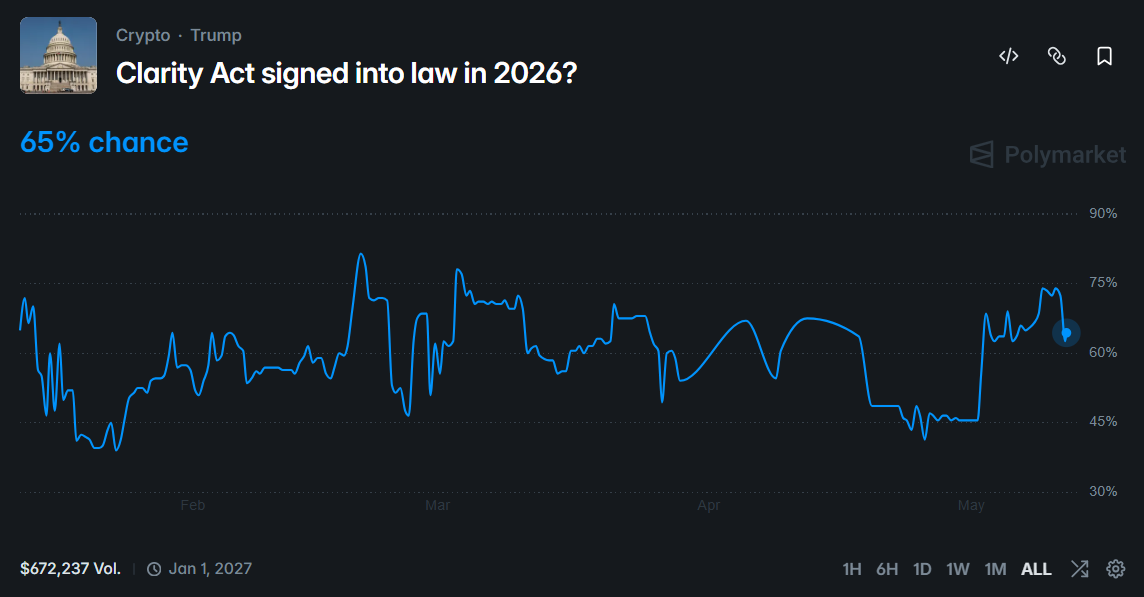
Polymarket traders currently give the Digital Asset Market Clarity Act a 65% chance of being passed into law in 2026.
That’s risen significantly from 46% at the beginning of May.
On a competitor platform, Kalshi, the odds are even greater, at 70%, that some type of crypto market structure legislation would be passed before 2027.
Markup back on the calendar
Excitement is building as the Senate Banking Committee officially reviews the bill on Thursday, May 14.
The meeting will be held at the Dirksen Senate Office Building in Washington, D.C.
This is the committee’s first significant opportunity to consider the idea since it was delayed in January, and the White House is allegedly hoping to have it signed into law by July 4.
According to reporter Eleanor Terrett, some industry insiders saw the draft wording before to the conference.
Lawmakers have been working on the measure for months, focusing on problems such as which authorities would govern it, consumer and developer rights, and stablecoin incentive regulations.
Many people in the crypto industry quickly praised the news.
Cody Carbone called the committee’s announcement “a major step” toward giving clear rules to the more than 70 million Americans who use or own cryptocurrencies.
Ji Hun Kim said, “The momentum is real, and the time is now,” adding that the proposed rules would protect consumers while supporting responsible growth.
Kristin Smith described the hearing as “a make or break moment” for America’s leadership in financial markets.
Summer Mersinger said that American consumers and innovators need clear regulations.
However, not everyone supports the bill.
Several financial trade groups sent a letter to committee leaders Tim Scott and Elizabeth Warren, raising concerns and asking for changes to the proposal.
Their biggest concern is a compromise on stablecoin payments suggested by Senators Thom Tillis and Angela Alsobrooks.
Banking groups want stricter rules, especially to stop stablecoin companies from offering interest or rewards to token holders.
Despite the friction, funds continue to come into cryptocurrency. Last week, investors poured $858 million into cryptocurrency funds, continuing a five-week trend of inflows.
Bitcoin funds alone raised about $700 million, bringing the year’s total to $4.9 billion.
James Butterfill, head of research at CoinShares, attributed the inflows to increased interest in the Clarity Act.
Grayscale thinks that if passed, the bill will usher in a new era of innovation and capital development by replacing legal ambiguity with precise principles.
Bitcoin was recently changing hands around $81,000.
Analysts say the next big move upward may depend on prices clearing the 200-day simple moving average, which sits just above $82,000.
The divide is clear. Prediction market participants are heavily betting on a policy-driven breakthrough that could accelerate crypto innovation and inflows regardless of higher-for-longer rates.
Meanwhile, macro analysts on Wall Street are bracing for tighter financial conditions weighing on the broader economy.
Wall Street braces for prolonged high rates
The mood in traditional finance is much more cautious.
Both BofA Global Research and Goldman Sachs have lowered their expectations for Federal Reserve rate cuts, citing sticky inflation caused by high energy prices and a stronger-than-expected labor market.
BofA now does not see any cuts this year, projecting two 25-basis-point reductions in July and September 2027.
Goldman Sachs moved its first expected cut to December 2026. “We think Warsh will push for lower rates, but the data flow precludes cuts for now,” BofA analysts wrote.
US Treasury yields are rising, and the continuous crisis in the Middle East is keeping energy prices high.
The April jobs report exceeded expectations, reinforcing the case for the Fed to stay put.
The divide is stark: crypto markets are betting on a regulatory breakthrough, whilst traditional investors expect interest rates to remain high for the foreseeable future.
The smartest crypto minds already read our newsletter. Want in? Join them.


Read More