


Bitcoin’s weekend crash below $60,000 can be linked to a deeper meaning relating to the May 2026 jobs report that came in far stronger than expected.
The report from the US Department of Labor shows a resilient labor market, but it also complicated the liquidity that risk assets had been trying to price in, leaving Bitcoin exposed at a time when confidence across crypto is already very low.
May Jobs Report Lands Very Strong
The Bureau of Labor Statistics reported on Friday that US employers added 172,000 jobs in May, more than double the consensus estimate of 85,000 from economists polled by LSEG.
The unemployment rate held steady at 4.3%, which would have been enough to rattle rate-cut expectations. Interestingly, there were revisions to the job numbers in prior months, which added a further 93,000 jobs to the March and April tallies combined, with March revised up to 214,000 and April revised up to 179,000.
The print was the second-strongest in over a year, and investment markets adjusted immediately. Following the release, Polymarket increased the probability of a Federal Reserve rate increase before year-end to 53%, while the CME FedWatch tool shows a 42.7% chance that rates will be higher by December. As it stands, prediction markets are pricing roughly a 68.8% probability of zero rate cuts in 2026.
Goldman Sachs Asset Management’s Lindsay Rosner, head of multi-sector fixed income investing, called the report a Payroll Blowout, and said the Fed has gained more and more confidence that it does not need to worry about the labor market.
Bitcoin’s Liquidity Is Braking Down
The Kobeissi Letter captured the scale of the reaction by noting that the S&P 500 erased nearly $2 trillion in market cap just hours after what it described as the third-strongest US jobs report in 18 months. The same post also noted that Bitcoin is now down more than 50% from its October 2025 record high, with the bear market gaining momentum this week and crushing risk appetite.
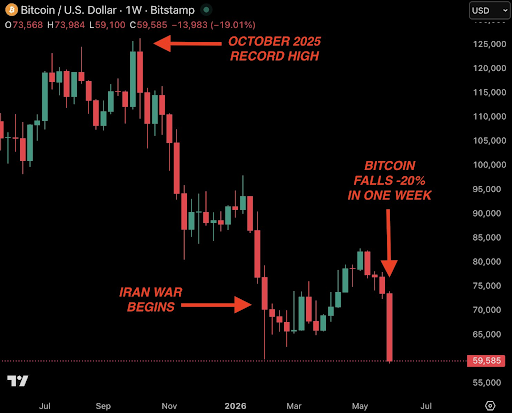
The brief crash below $60,000 over the weekend also showed that traders are reacting to a broader message that liquidity is drying up. Spot Bitcoin ETFs have been dealing with heavy outflows in recent weeks, reducing one of the most important sources of marginal demand that supported the cryptocurrency during its rally in early May.
However, Bitcoin bulls may still have one reason to stay hopeful. Bitcoin slipped through its 200-week moving average over the weekend, which currently sits at $61,000, leading to its first major interaction with the level since 2022.
Data from Coinglass shows that Bitcoin has historically found bear-market bottoms around the 200-week moving average across major cycles between 2015 and 2020. The last time Bitcoin tested this line was in June 2022, making the latest breach, almost four years later, a notable moment in the current downturn.
Standard Chartered’s global head of digital assets research, Geoff Kendrick, told clients on June 4 that the bear market may be in its final stages, noting that the recent painful week of price action might be the buying zone we all wanted when Bitcoin returns to $100,000 and Ethereum returns to $4,000.
The post Bitcoin Crash Says Liquidity Is Dying As May Job Report Comes Back With Staggering Numbers appeared first on Bitcoinist.




Read More