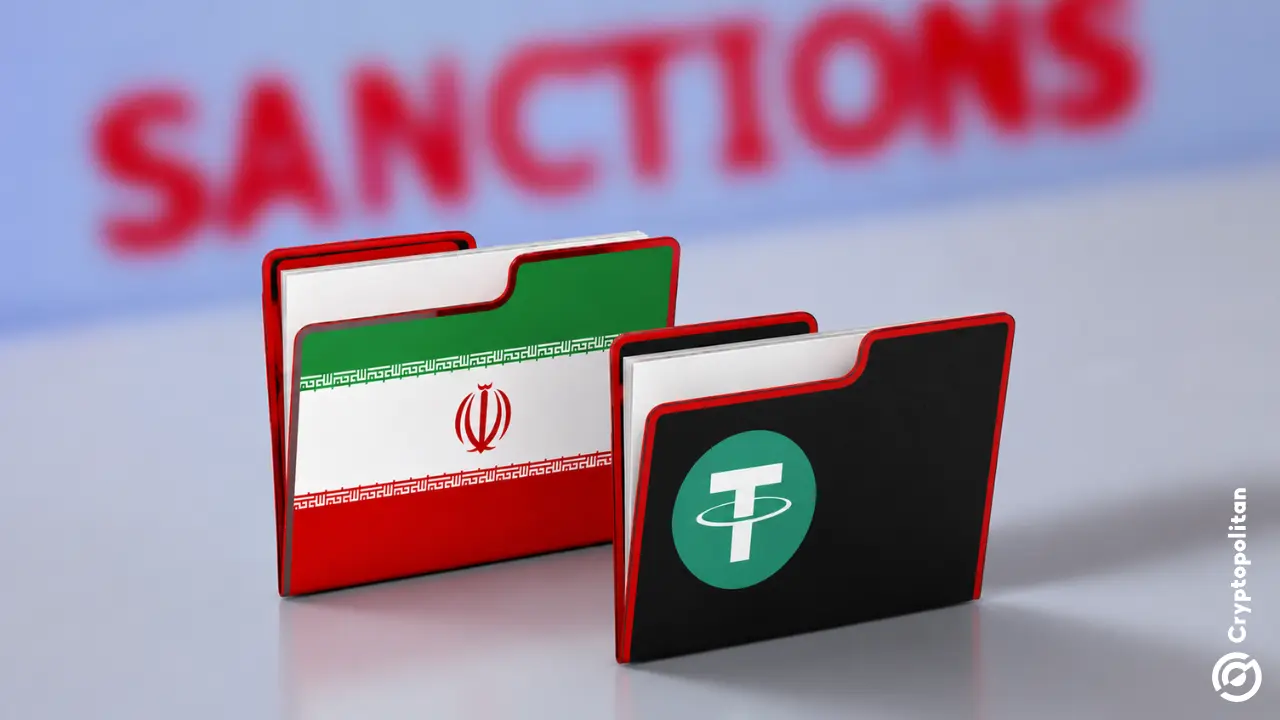


On Tuesday, the US Treasury, along with Tether, froze approximately $131 million in USDT funds linked to Iran’s central bank, demonstrating how the effective work of stablecoin infrastructure initially designed to facilitate instant and cost-efficient transfers is also exploited by the parties sanctioned by the US government.
USDT (stablecoin pegged to US dollars by Tether) is characterized by speed, liquidity, and the ability to transact across the globe at effectively no cost. All these properties make it a suitable tool for normal trading and a target for highly sanctioned regimes. The events of the current week show the other side of the coin, however: given that transfers are mostly publicly visible on the blockchain and controlled by a single issuer, tracing and blocking the transactions is comparatively straightforward.
What the Treasury did
Scott Bessent, the Treasury Secretary, stated the news on X, noting that the Office of Foreign Assets Control (OFAC), which is the body responsible for the implementation of US economic sanctions, has taken action against several wallets associated with Iran’s Central Bank.
On Tuesday, Bessent commented that the “US Treasury is committed to disrupting and degrading Iran’s illicit financial activities, including its abuse of digital assets… We will continue to aggressively follow the money and deny the Iranian regime access to the proceeds of its illicit revenue schemes.”
The on-chain footprint was detected first. Blockchain investigator Specter pinpointed four Tron wallets containing approximately USD 131 million in USDT, which Tether had blocked prior to Bessent linking the wallets to the central bank of Iran.
Tether has just frozen four TRON wallets holding a total of $131M USDT.
Looking at the source of the funds, most were withdrawn from DTC Pay, a payment service provider, and Bitso, a cryptocurrency exchange.
The reason behind the blacklisting is still unknown.
Stay smart. pic.twitter.com/MM9V582Yhk
— Specter (@SpecterAnalyst) July 14, 2026
The freeze struck as the truce between the US and Iran fell apart. Washington has reinstated its blockade of Iranian ports, and US Central Command has carried out new attacks. Meanwhile, Iran’s military claimed it had carried out drone attacks on US troops stationed at Al Azraq Air Base in Jordan. Digital currencies have become an essential tool in this ongoing fight.
Another Iran-linked crypto crackdown
This is the second occurrence this year when a seizure was made of an amount in the 9-figure range. In April, Tether claimed to have “supported the US government in freezing” $344 million in USDT from two addresses after receiving information from US authorities on illicit activities. A US official informed CNN that the seized money had “material links to the Iranian regime” through trading on the Iranian market and methods of transfer through intermediary addresses and wallets owned by the Central Bank of Iran, although CNN stated that it was unable to verify the connection.
The operation that took place in April to Operation Economic Fury, a campaign started by the US in March 2025, whose goal was to block the flow of money to Iran generated by oil trading. By May, Bessent claimed that around $1 billion in Iranian crypto had been seized as part of that effort.
Surveillance over the stablecoin market is indispensable for all of this to work. Tron being public in nature means that companies and issuers can monitor money flows virtually in real-time. Tether, TRON, and data analytics company TRM Labs have come together to establish the T3 Financial Crime Unit, which claims that over $450 million in dubious USDT has been frozen since September 2024.
TRM takes care of tracing funds, TRON helps with network visibility, and Tether is responsible for the freezing of assets on its ledger. According to TRM, a stablecoin issuer is capable of freezing an address, burning tokens, and reissuing clean money on-chain, which is impossible for banks to do with the money in their custody.
The monitoring activities of the industry are becoming increasingly transparent too. Together with Allium Labs, Visa has now launched a public dashboard that provides data on the movement of stablecoins backed by fiat currencies across various blockchains and also contains the sender and receiver addresses. Cryptopolitan has reported before that regulators and payment companies and stablecoin issuers are increasing their investments in the tools for monitoring blockchain transactions as the adoption of stablecoins for payments becomes more widespread.
Does it hurt Iran?
The effect could be less significant than indicated by the headline figures.
As reported on CNN, Daniel Tannebaum, a senior fellow at Atlantic Council, called the April freeze “meaningful,” but claimed, “I don’t think it necessarily moves the needle” against a nation that has been functioning under international sanctions for years. In Tannebaum’s opinion, the bigger pressure is exerted by third-country actors, especially China, which trades with Tehran in spite of the imposed restrictions.
At this point, the key items to pay attention to are whether Tether’s frozen Tron wallets remain frozen, whether OFAC adds the relevant addresses to its sanctions lists, and whether the focus will change to the exchanges and refiners transferring Iranian value across the borders.
Don’t just read crypto news. Understand it. Subscribe to our newsletter. It’s free.



Read More