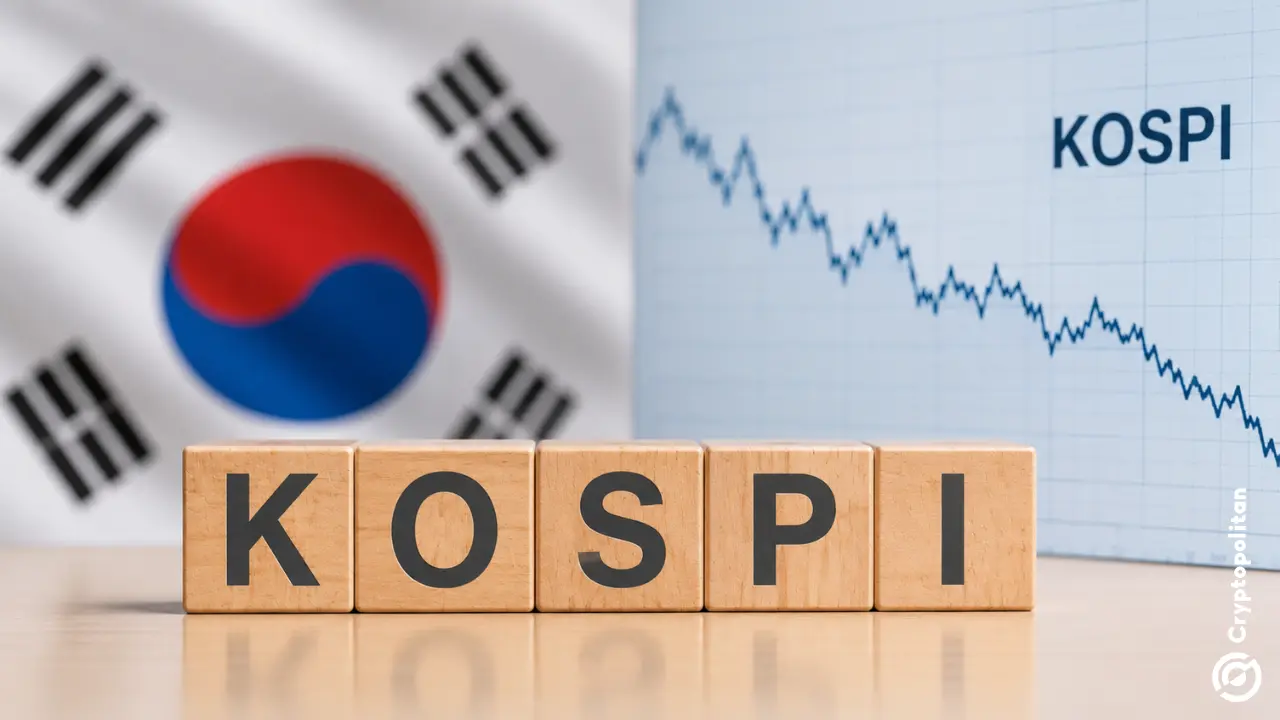


The South Korean KOSPI index had its eighth circuit breaker for 2026, after another 8% loss. The index is closely watched for signals on the AI and semiconductor trades.
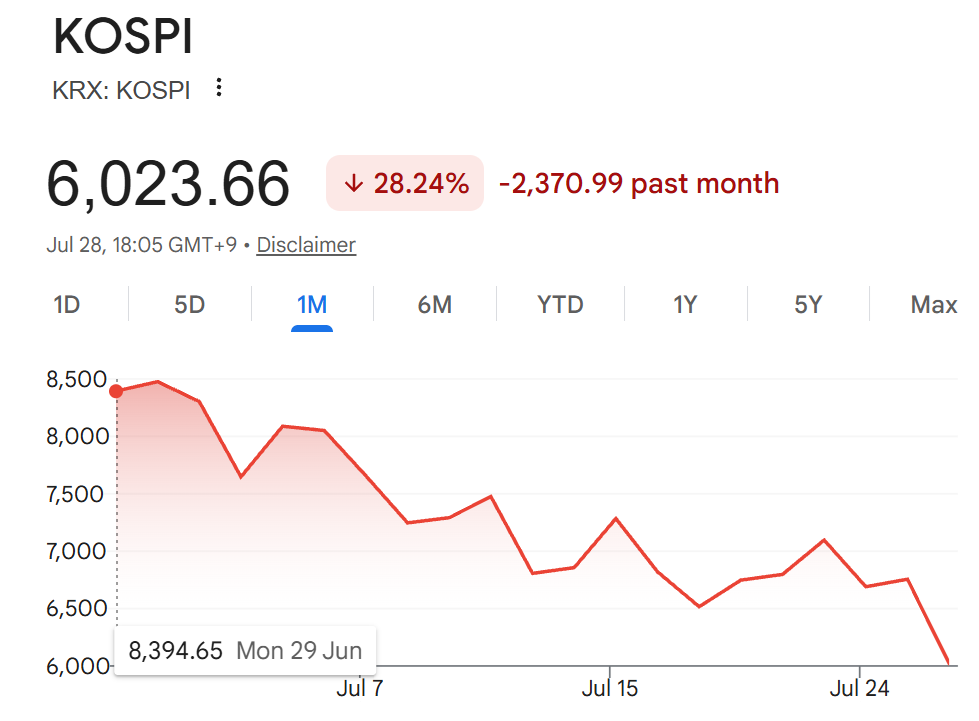
The South Korean KOSPI index hit another circuit breaker for the eighth time this year. The index broke down along with other markets. KOSPI extended this year’s crash, coinciding with market-wide weakness.
KOSPI erased 520B Korean won, or around 360B US dollars. Additionally, some of the South Korean stock positions were used as collateral, leading to more potential losses as leverage unravels. During the market crash of July 9, some considered the drop a final move for KOSPI, but the index continued to slide, dropping by over 20% in the past weeks.
Additionally, the SK Hynix index is down 50% from its June high, due to weakness in the memory stocks sector. Multiple memory producers fell after the Changxin Memory Technology (CMXT) IPO on Monday.
The South Korean market responded to a drawdown of US chip stocks and a 4.4% Nvidia (Nasdaq: NVDA) drop. Micron (Nasdaq: MU) and SanDisk (Nasdaq: SNDK) were also among the top losers, down 5% and 10%.
Asian markets followed, with a 4% drawdown for Nikkei. At this time, BTC also dropped from its new price range, and dipped to $63,000.
Why did KOSPI drop?
KOSPI has behaved with extreme volatility in 2026, on a mix of retail trading and the influence of semiconductor stocks. As Cryptopolitan reported, just before the crash, KOSPI was showing signs of recovery and a close in the green.
Yet the AI and chip stock recovery was fragile. The trigger for the drop was the recent news of Nvidia backing OpenAI with a $250B backstop of financing a new data center. Nvidia will also set aside $350B for OpenAI to purchase its own chips, and the market priced in the ‘circular financing’ of the AI economy.
Those financing deals are pushing up the price of debt, calling into question the viability of AI scaling.
Since Samsung makes up 50% of the KOSPI index, the drop was rapid, causing liquidations and leading to the circuit breaker.
What does KOSPI indicate for the crypto market?
As of 2026, BTC lost its correlation to AI and chip stocks, moving significantly below the trend. The unraveling of KOSPI may bring some liquidity back into crypto if the AI narrative weakens.
The increased volatility of KOSPI is also not a problem for crypto traders. On-chain exchanges have taken on the challenge. Dextera Labs mentioned the possibility of launching a KOSPI-based perpetual futures market, potentially betting on other dramatic events. A futures market on KOSPI may allow traders to speculate on an eventual short squeeze, or a further drop.
On-chain trading for KOSPI would be viable due to the strong directional moves of the index. Currently, the market is still waiting for the end of de-leveraging. Currently, KOSPI is also waiting for signals on whether it will see liquidity outflows or merely the repricing of risk in AI and memory stocks.
Speculation on KOSPI has also replaced token and altcoin trading, which remained popular for retail traders in South Korea.
Don’t just read crypto news. Understand it. Subscribe to our newsletter. It’s free.


Read More