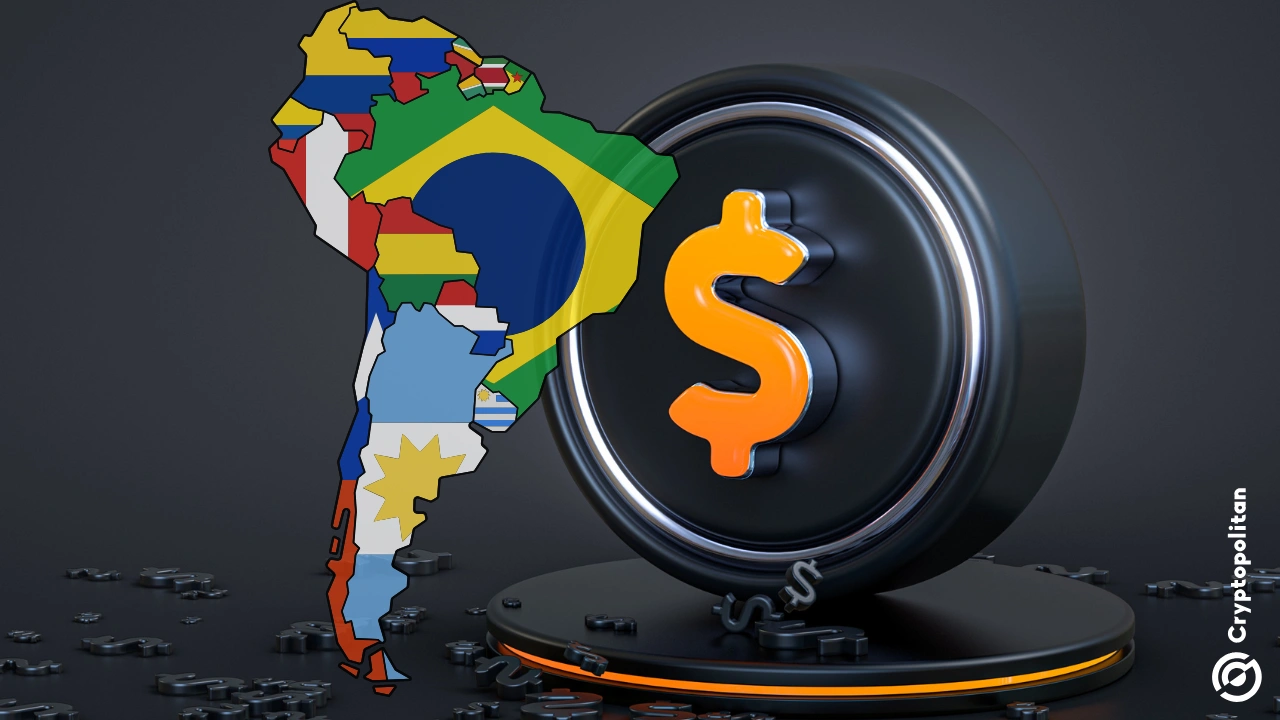


South America’s largest economies are not waiting for a regulatory green light to press on full throttle with their crossover into digital asset alternatives, with Brazil and Argentina becoming the latest to plant their flags in the push for new financial territories.
The shift was reiterated this week as the International Monetary Fund (IMF) reported that crypto rails now carry a majority of Brazil’s cross-border fund transfers, around the same time that news broke of Argentine banking groups building their own peso stablecoins, even though the central bank currently has a ban in place.
Brazilians now send more crypto traditional capital
The IMF’s latest Financial System Stability Assessment of Brazil, reviewing the state of Latin America’s largest economy, came back with a headline finding that emphasized the scale of crypto’s impact. Digital assets, especially stablecoins, have become the primary mode of sending money in and out of Brazil, after steadily climbing since 2017 to overtake the run rate of conventional channels.
As for the appeal of stablecoins for companies and retail users, the IMF’s first such review of Brazil’s economy since 2018 pointed to cheaper transfers and tax advantages.
Why is the IMF cautious about Brazil adopting crypto?
The IMF also noticed correlations between stablecoin demand and economic indicators such as the S&P 500, the VIX volatility index, and Bitcoin’s price, exchange and interest rates, and tax policy shifts. Those findings, according to the fund, show how the digital asset pivot has found its place within the country’s broader economic structure.
While some cheer, the IMF has instead raised red flags about some of the areas that the Central Bank of Brazil has not covered in its supervision of virtual asset service providers. The problems that the fund raised were:
- Inadequate legal protection for users
- Unclear standards for handling assets held in custody
- Travel Rule inadequacies
- Lagging fund transfer tracing and anti-money-laundering standards
The Brazilian Congress is already working on bringing the digital asset under proper legislative coverage. Bill 4308/2024 is expected to clearly define legal boundaries for stablecoins, although there is already a domestic push not to classify them as electronic money.
Closing those gaps, the report argued, will require Brazilian regulators to share reporting duties with counterparts abroad.
Argentina’s banking giants move on stablecoins
South of the border, the appetite is for stablecoins denominated in the local currency of the third-largest economy in LATAM. Citing Iproup, two banking conglomerates are reportedly readying peso-pegged tokens aimed at institutions rather than everyday savers, for servicing treasury operations, payments triggered by on-chain events, and collateralized lending.
One of them, BIND Group, which manages more than $2 billion in assets and owns BIND Banco Industrial, is building its token through BEN, an in-house virtual asset service provider. The move tracks with reports from earlier in the month when the banking giant entered a partnership with Circle to serve institutional clients.
The other of the duo, The Petersen Group, which owns and runs several regional banks, is advancing a separate DIPE product. Its own effort comes with the support of Lirium, a crypto-as-a-service firm, and already has a whitepaper.
Will the 2022 ban affect their plan?
Argentina’s central bank has barred private banks from offering crypto services directly since May 2022. That’s why both banks are running their plans through subsidiaries.
Those workarounds may not even be necessary as the central bank is reportedly looking at lifting the ban. That path is not yet clear, though, as the country’s securities regulator blocked the argt peso stablecoin because they regarded it as a security offered without the required compliance.
Why local-currency stablecoins are the next contest
The push for home-grown tokens reflects a broader argument in the region. Writing for the World Economic Forum, Ripio founder and CEO Sebastián Serrano noted that dollar-backed coins such as Tether’s USDT have taken hold in Latin America as a hedge against inflation, but warned that leaning on foreign-issued digital dollars erodes the tools policymakers use to manage their own money supply. His pitch is for stablecoins backed by domestic currencies instead.
The scale explains the stakes. The Digital Chamber reported $324 billion in stablecoin transaction volume across Latin America in 2025, an 89% jump year over year, with stablecoins accounting for over 90% of crypto flows in Brazil and more than 60% in Argentina. The same report found 71% of Latin American institutions already using stablecoins for cross-border payments, the highest rate of any region.
Don’t just read crypto news. Understand it. Subscribe to our newsletter. It’s free.




Read More