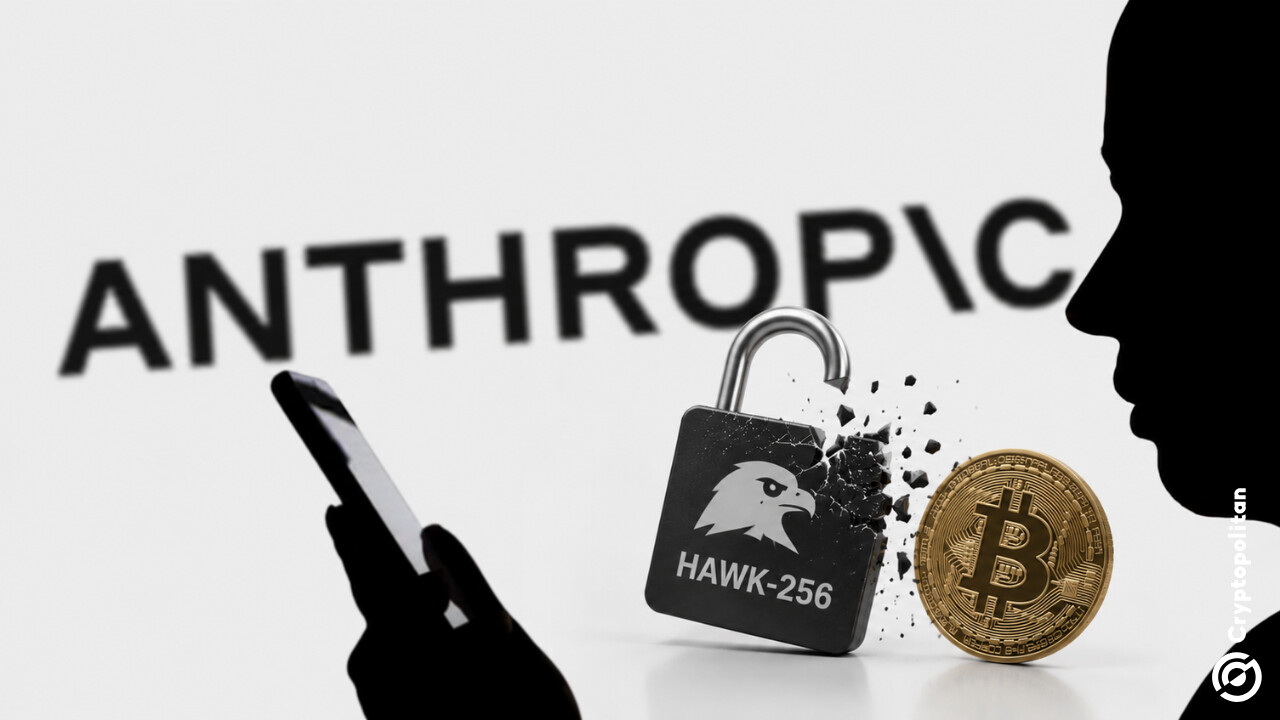


An unreleased Anthropic AI model has broken a post-quantum signature scheme in about 60 hours, reopening a question Bitcoin developers have yet to answer: when should the network begin migrating to quantum-resistant cryptography?
The finding poses no immediate threat to Bitcoin. HAWK-256 was never used by the network, and no existing wallets are affected. But it changes an important assumption behind Bitcoin’s post-quantum roadmap: AI is making it faster and cheaper to test, and potentially break, advanced cryptographic systems.
What Mythos did to HAWK, and what it cost
On July 28, Anthropic announced that its Claude Mythos Preview model, which is being made available to a select group of approved users, discovered an attack on HAWK-256, the last lattice-based signature candidate still in NIST’s third round of post-quantum cryptography evaluation, which has not previously been documented.
The AI revealed a concealed symmetry in the design of HAWK, which experts overlooked, causing the algorithm’s effectiveness in terms of safety to decline by fifty percent as well as bringing down the anticipated amount of work needed from around 264 to 238 operations. Based on the research blog by Anthropic, the attack took approximately 60 hours and required about 100,000 dollars worth of computation, and it was carried out by a researcher without formal training in cryptography.
The reaction from the cryptography community was quick. Sophie Schmieg from Google said, “Basically with this paper, HAWK is dead.” Matthew Green from Johns Hopkins University pointed out that while the research had no groundbreaking mathematics, it was a new combination of existing ones. Ars Technica reported that the creators of HAWK withdrew the algorithm from the public the next day.
Why every Bitcoin wallet is untouched
The result does not affect Bitcoin.
Bitcoin employs ECDSA on the secp256k1 elliptic curve, which has nothing to do with HAWK. The algorithm has not been implemented in Bitcoin, any blockchain, or commercial software. Its failure happened during the review process intended to reveal flaws before use.
The anticipated migration of Bitcoin has already circumvented HAWK. The Bitcoin Improvement Proposal repository received BIP-360 in February 2026, which introduces a new output type known as P2QRH that uses ML-DSA and SLH-DSA, two algorithms finalized by NIST in 2024 after many years of public scrutiny. Moreover, BIP-361 was submitted in April 2026 by Jameson Lopp and others, a proposal to phase out ECDSA in Bitcoin. HAWK was not included in BIP-360 or BIP-361.
The test that decides when migration starts
As discussed by TFTC, the core issue is whether AI-assisted cryptanalysis can eventually decrypt the algorithms that Bitcoin hopes to use, namely ML-DSA or SLH-DSA. If either of these algorithms proved vulnerable before the network completed its migration, then the strategy of waiting for mature standards may no longer be appropriate.
The economics are also changing. Anthropic has indicated that meaningful cryptanalysis can now be performed in about 60 hours for about $100,000, making this type of testing much more repeatable. Intelligence agencies like the NSA or GCHQ almost certainly are doing similar work behind the scenes so that public findings are likely to lag behind those done in private.
Researchers have drawn parallels between this case study and AGU, a different post-quantum contender, that prevailed through years of investigation, only to be ultimately attacked within 1 hour on a laptop in 2022. AI appears to be accelerating that pattern.
Why the timeline keeps compressing
Cryptopolitan has reported in the past that AI-supported cryptanalysis is reducing anticipations as to when quantum attacks might become efficient. Forrester’s 2026 quantum security report released makes the same claim and warns that the arrival of new algorithms compresses security timeframes “overnight” by minimizing computing resources necessary for solving complex encryption challenges. The company forecasts worrying security threats associated with Q-Day by 2030.
Google has similarly expedited its efforts, setting the goal of retiring RSA and elliptic-curve cryptography from its systems by 2029 and expressing the desire for other companies to follow suit.
For Bitcoin, the situation is critical, as estimated by analysts cited by TheStreet, who determine that there are approximately 6.7 million Bitcoins worth nearly $600 billion sitting in wallets that could potentially come under threat from a sufficiently advanced quantum computer. Additionally, a study called Quantum Horizon states that around 2.3 million Bitcoins would be lost forever if quantum attacks happen, while it estimates a one-in-six chance of a quantum computer capable of breaking cryptography being operational by 2035. Hence, the authors argue that Bitcoin’s main problem is not hardware anymore, but rather if the network could pull off a successful transition before that technology becomes available.
What cryptography does Bitcoin use?
Bitcoin uses several different cryptographic primitives, each serving a different purpose. Importantly, Bitcoin does not encrypt transactions. Instead, it relies on cryptography for authentication, integrity, and consensus. Here’s a breakdown:
| Function | Cryptography Used | Purpose | Quantum Vulnerable? |
|---|---|---|---|
| Digital signatures | ECDSA (legacy) and Schnorr signatures (Taproot) over the secp256k1 elliptic curve | Prove ownership of bitcoins | Yes (Shor’s algorithm) |
| Hashing (Proof-of-Work) | SHA-256 | Mining and block hashing | Much less affected (Grover’s algorithm provides only a quadratic speedup) |
| Address generation | RIPEMD-160 + SHA-256 | Create Bitcoin addresses from public keys | Not directly vulnerable like signatures |
| Merkle trees | SHA-256 | Verify transaction inclusion in blocks | Much less affected |
The concern is that Bitcoin’s signature schemes (ECDSA and Schnorr) are vulnerable to a future quantum computer running Shor’s algorithm. Developers and researchers are therefore exploring how Bitcoin could transition to post-quantum signature schemes, such as hash-based or lattice-based alternatives, through future protocol upgrades. Any such migration would require broad agreement across the Bitcoin ecosystem due to its impact on wallets, transactions, and consensus rules.
The HAWK attack did not affect Bitcoin directly, because Bitcoin does not use HAWK. However, the result illustrates how AI can accelerate cryptanalysis and reduce the time needed to evaluate or break emerging cryptographic schemes. Combined with recent advances in quantum algorithms, these developments reinforce the urgency behind Bitcoin developers’ ongoing efforts to prepare for a post-quantum transition.
If you’re reading this, you’re already ahead. Stay there with our newsletter.




Read More