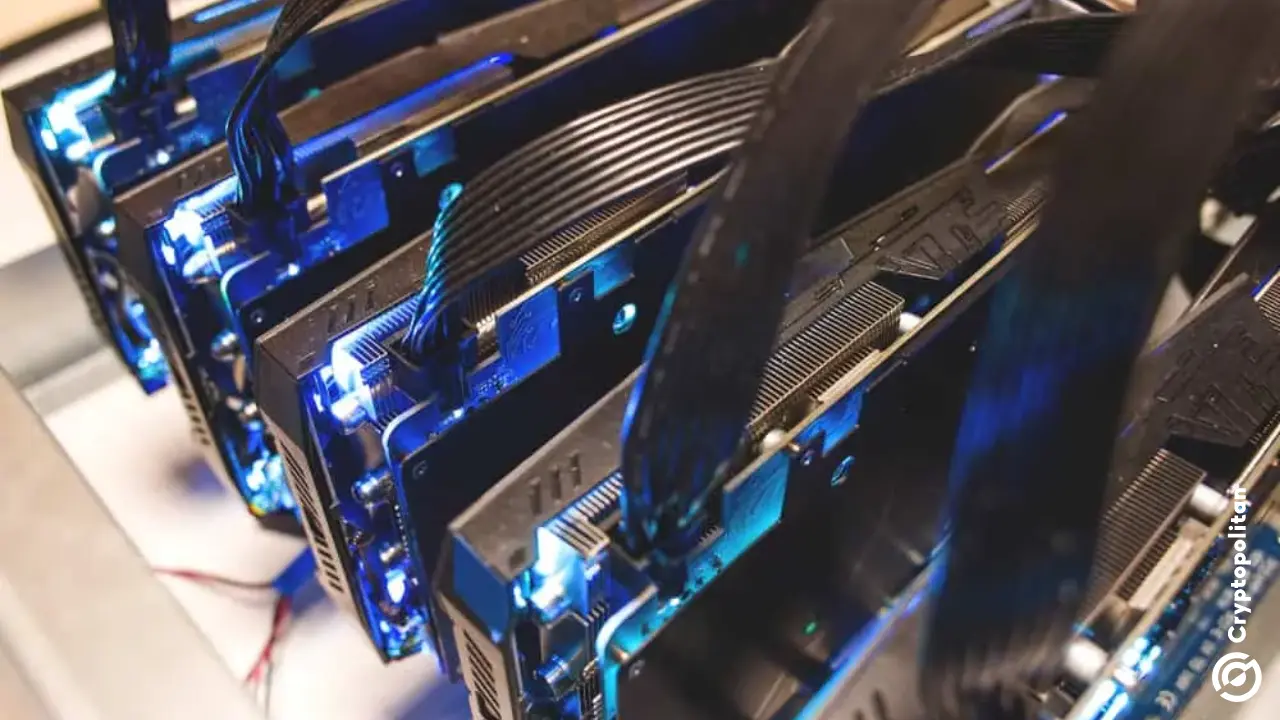


GPU compute is entering a new period of market-based price discovery. Companies are no longer hoarding compute power for internal use, and crypto may have another competitive offer on the table.
GPU compute is shifting from internal usage to third-party clients. As Cryptopolitan reported earlier, Meta was among the big movers to offer AI GPU compute, redirecting some of the power from internal usage to external clients.
After a wave of large-scale capital expenditures, the advantage of GPU compute is still undecided. Frontier models and internal usage compete with the potential to release both spare capacity and more powerful models to external users.
Optimizing the market and allowing comparisons will open a new wave of competition for the best offers on GPU compute.
Is crypto competitive in GPU compute?
Crypto projects have focused on AI infrastructure for years. The sector, known as DePIN, has already created several marketplaces. Usually, DePIN projects aggregate idle available GPU compute power from data centers, as well as consumer electronics. Some of the DePIN projects turn this market into the basis of participation and network security.
This secondary market often undercuts traditional cloud providers. Prices from traditional providers range from $3.93 to $10.68 per hour, depending on the model or available GPU capacity.
For DePIN competitors, the secondary market allows prices to fluctuate, often undercutting the leading GPU providers. Average prices show that some task-specific or general networks can compete in the newly expanding market for third-party computation.
| Crypto Project (Token) | H100 (SXM5) Pricing | A100 (80GB) Pricing | Mid-to-Low Tier | Structural Edge & Ecosystem Focus |
| Akash Network
(AKT) |
~$2.30 – $3.68 / hr | ~$1.10 – $1.45 / hr | ~$0.30 – $0.50 / hr | Automated reverse-auction bidding where providers compete to offer you the lowest price. The market is based on the Cosmos network. |
| io.net
(IO) |
~$1.85 – $2.69 / hr | ~$0.89 – $1.20 / hr | ~$0.25 – $0.40 / hr | Specializes in cluster-building, allowing users to link up to thousands of decentralized GPUs for massive AI training workloads. |
| Render Network
(RENDER) |
N/A (Job-based) | N/A (Job-based) | ~$0.15 – $0.35 / hr equivalent | Built strictly for 3D rendering and motion graphics, specialized market for artists. |
| Aethir
(ATH) |
~$1.90 – $3.10 / hr | ~$0.95 – $1.30 / hr | ~$0.20 – $0.45 / hr | Focuses heavily on low-latency edge computing and enterprise-tier inference. GPU compute sourced from over 90 countries. |
| Theta EdgeCloud
(THETA) |
~$2.29 – $3.40 / hr | ~$1.20 – $1.50 / hr | ~$0.25 – $0.45 / hr | Originally a decentralized video delivery network, it has evolved into a generalized AI computing market supporting text-to-video, LLMs, and media processing. |
Following the recent increase in interest in the compute market, the DePIN sector recovered slightly. Top DePIN coins and tokens are valued at $7.87B, rising by 3.1% in the past 24 hours.
A16Z backs new GPU compute market
The major flaw of GPU compute offerings is the lack of a common settlement space. For crypto, this means market fragmentation, where every project has a different target audience and limited users.
Currently, there are also concerns that some of the newly built GPU capacity may be sitting idle, after the initial wave of hoarding the best available GPUs.
In anticipation of a new wave of reselling GPU compute, A16Z has backed a marketplace project to boost price discovery.
Odig, a Web3 project, is building such a marketplace, backed by several large-scale VC funds. Odig raised $33M in a seed round led by A16Z, with the participation of Galaxy Ventures, Nordstar, Crucible Capital, and others.
The appearance of a compute market may make Web3 viable again, tapping the experience in organizing decentralized marketplaces and real-time price discovery.
If you’re reading this, you’re already ahead. Stay there with our newsletter.




Read More