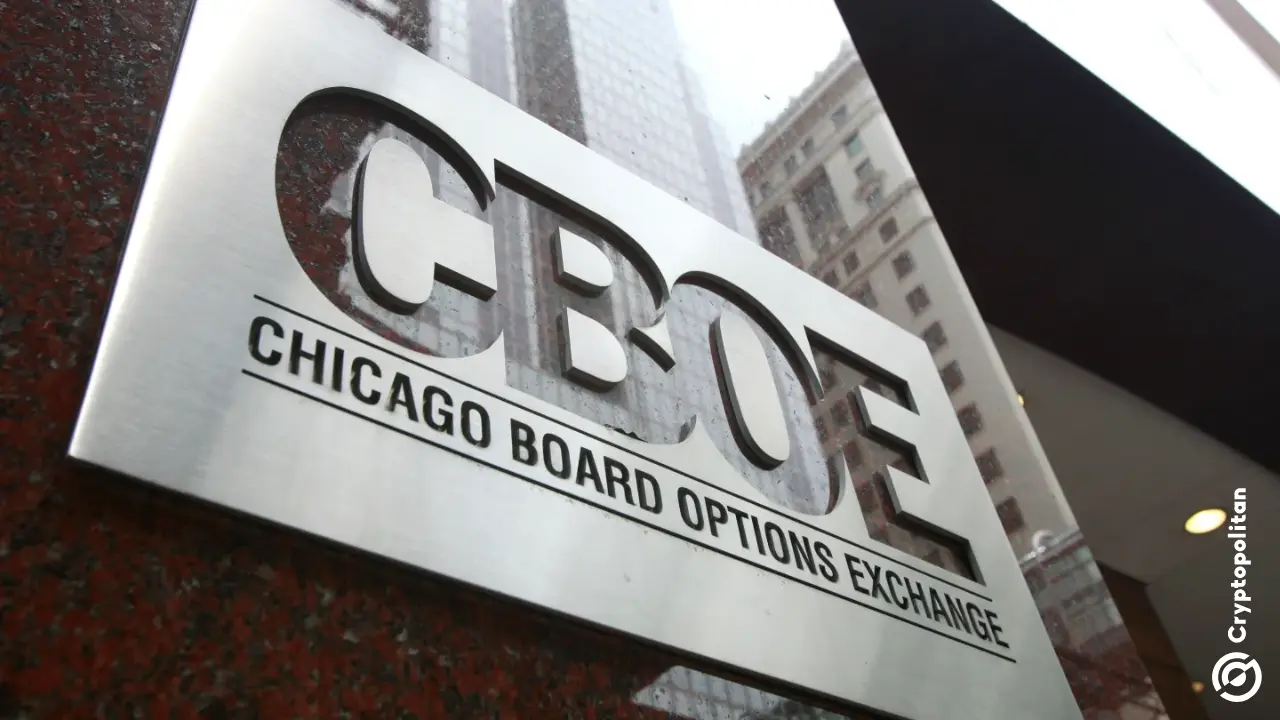


Chicago Board Options Exchange (Cboe) may be considering a possible transition from Bitcoin and Ether continuous futures into perpetual type of instruments. This transition would bring a crypto-native derivatives design further into regulated U.S. markets and would result in growing competition between exchanges that target a perpetual market worth $61.7 trillion in annual trade volume.
This idea was disclosed by Nate Geraci, president of ETF Store, on X on June 23 as another proof of traditional exchanges adopting market structures initially established by offshore cryptocurrency platforms. Currently, Cboe is offering Bitcoin Continuous Futures (PBT) and Ether Continuous Futures (PET), both being cash-settled derivatives designed to provide long-dated exposure with daily cash settlement replicating a rolling futures mechanism.
Cboe’s continuous futures
In 2022, Cboe entered regulated, CFTC-underwritten crypto derivative markets with continuous contracts for Bitcoin (PBT) and Ether (PET) – offering a cash-settled approach to trading perpetual contracts on a day-and-night basis. While conventional futures traders are obliged to shift positions to the following delivery dates to maintain exposure to their underlying asset, PBT and PET settle daily to spot crypto indices and roll automatically.
Cboe considering converting its btc & eth continuous futures into perpetual futures…
Entrenched tradfi incumbents are now continually forced to react to crypto-native innovations.
Just the beginning.
via @kryshur @Vlajournaliste pic.twitter.com/SKeCUQe4uh
— Nate Geraci (@NateGeraci) June 23, 2026
However, open interest in and volume for Cboe’s PBT and PET, particularly when compared with the CME Bitcoin futures market, is considerably thinner. Cboe hasn’t disclosed how much open interest each continuous product has, but industry sources indicate that they are nowhere near as developed as the CME Bitcoin futures and options products, which each typically carry several billion dollars of open interest against maturities. The contrast highlights CME’s position as the dominant institutional venue for crypto derivatives, while Cboe’s continuous futures stand out as an alternative market structure designed to simplify trading and reduce rollover friction.
Moving from continuous futures to perpetual futures would essentially eliminate expiry, substituting an extended rolling arrangement with an indefinite contract based on the funding rate formula.
Importance for the global crypto market
Perpetual futures contracts are the most traded products in offshore crypto trading venues like Binance, OKX, and Bybit, where the bulk of leverage trading of BTC and ETH takes place. According to market statistics referenced by CryptoQuant, the volume of trades in perpetual futures contracts reached some $61.7 trillion in 2025, reflecting the active turnover of these contracts instead of net market sentiment.
Regulators are starting to respond to the demand. On May 29, the Commodity Futures Trading Commission (CFTC) released policy guidance and approvals allowing regulated markets more leeway to offer perpetual-style derivatives. This included the approval of the perpetual-style Bitcoin contract offered by Kalshi, along with interpretative guidance offering exchanges greater leeway to design cryptocurrency derivatives.
Competitive dynamics in regulated
Derivatives exchanges in the United States and hybrid derivatives exchanges are competing with each other by offering varying versions of perpetual exposure with key differences in terms of structure, liquidity, and regulation.
Kalshi provides perpetual exposure to Bitcoin through a regulated event contracts framework, whereas CME Group is continuing to offer traditional Bitcoin futures with monthly and quarterly expirations that serve as institutional benchmarks for pricing and hedging.
Coinbase takes a different approach. Through its derivatives platform and intermediary arrangements, U.S. users can access offshore perpetual futures liquidity under recently clarified regulatory guidance. Rather than listing perpetuals domestically, Coinbase connects traders to markets that already exist abroad.
Cboe occupies a middle ground. Its Bitcoin (PBT) and Ether (PET) continuous futures already feature daily funding-like adjustments and maturities extending up to 120 months. That structure resembles perpetual contracts more closely than CME’s fixed-expiry futures, meaning a shift to true perpetuals would be an evolution of an existing design rather than a wholesale product overhaul.
Regulatory pressure and repositioning of markets
The May 29 policy change by the CFTC prompted quick repricing of the stocks in the U.S. exchanges, as investors began to evaluate the implications of this increased competition in derivatives. According to reports from the market, Cboe shares went down by 9% at the start of June, while CME Group and Intercontinental Exchange followed suit, as perpetual style derivatives were anticipated to squeeze margins and fees out of the business.
On June 18, CME added fuel to the fire by suing the CFTC on the grounds that perpetual futures should be deemed swaps according to the Commodity Exchange Act and that the CFTC had overstepped its boundaries. The CFTC rejected the claim, defending its stance as part of broader market modernization efforts.
What traders and institutions need to watch for
The key determining factor here is whether liquidity will migrate to regulated perpetual-like products. If institutions decide to participate in the regulated perpetual-like product market, then part of the trading volume will transfer from offshore exchanges, where currently cryptocurrency prices are discovered, and trading with leverage takes place.
However, this scenario does not seem likely at the present time. Since the margin requirements, maximum leverage, and maximum positions on the U.S. exchanges will be higher than offshore ones, conditions will be more favorable for risk management, although less favorable for profit-making.
The way the industry will go because of this balance between risk management and profit-making is yet to be seen. Regulation may be an advantage for institutions, while active traders will consider whether regulated perpetuals are better than other things offered by offshore exchanges.
So far, Cboe has not said anything about its plans or submitted any documents for the regulated perpetual. However, since CME is involved in a lawsuit, Coinbase uses offshore exchanges, and Kalshi launched regulated perpetual-like products, the competition remains high in the U.S. derivatives market.
The smartest crypto minds already read our newsletter. Want in? Join them.




Read More