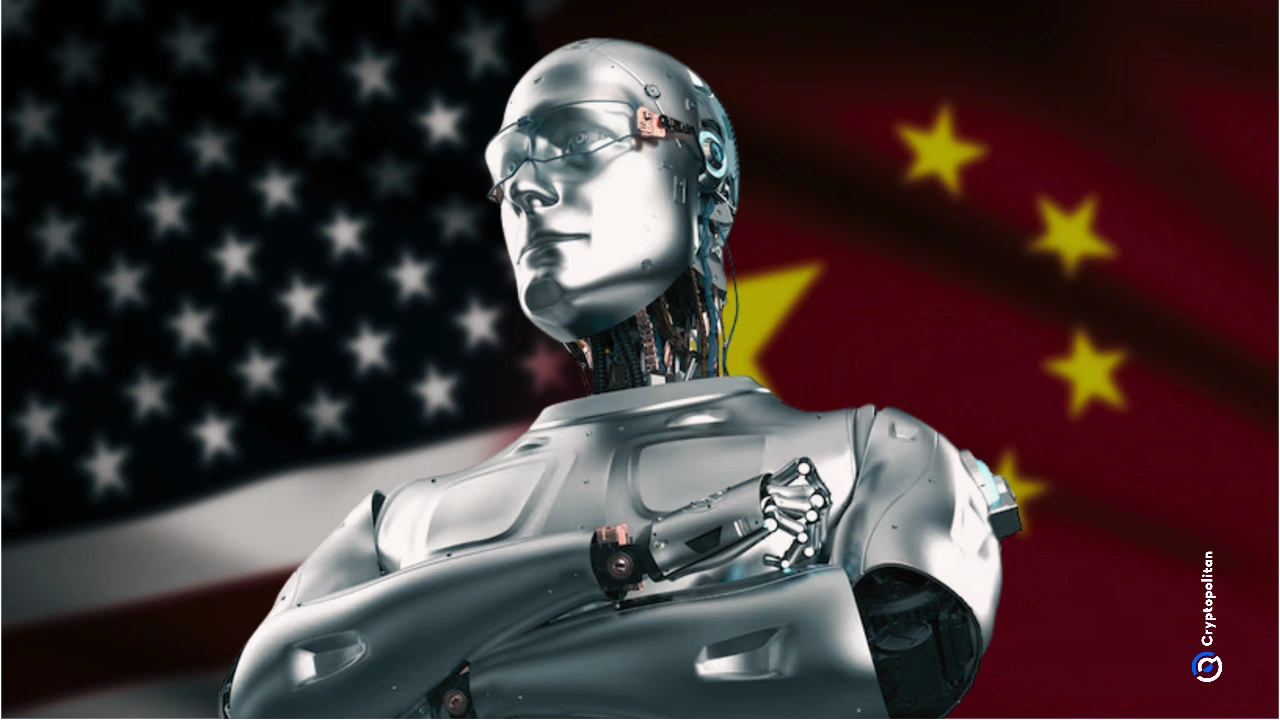


China is focusing its artificial intelligence efforts on robotics, making them a key part of its 15th Five-Year Plan. Meanwhile, the United States is actively working to keep its lead in advanced models and chips, with Chinese labs fast catching up.
This difference will be clear at the 2026 World Artificial Intelligence Conference in Shanghai, which starts on Friday, July 17, when Chinese companies plan to showcase all the hardware they’ve been working on.
Swancor Advanced Materials promised to introduce the Quester1, a personal robot that can switch between wheeled, bipedal, and quadrupedal forms on a single chassis. This follows other recent launches, like Unitree’s large GD01 manned mecha in May and LimX Dynamics’ modular TRON 2, which was unveiled in December 2025 and can change between dual-arm, bipedal, and wheeled-bipedal setups.
The money behind the changes
George Chowdhury, a robotics analyst at ABI Research, shared that the new five-year plan will likely include about $300 billion in subsidies for robotics and AI.
Private investors are also getting involved, with Ant Group recently leading a $73.58 million funding round for the humanoid startup Zeroth, its 12th deal of this kind since early 2025. According to reports, there are now more than 150 humanoid robot companies in China, with AgiBot and Unitree leading 2025 shipments.
According to Chowdhury, China shipped about 97% of the world’s humanoid robots last year, or around 19,000 units. This was made possible by relaxed safety rules that allow these robots to appear in entertainment and public spaces.
Jan Liphardt, founder of the robotics software company OpenMind, also noted that this growth was not sudden but came from investments made over 15 years ago and supported by China’s electric vehicle supply chain. “If you understand EVs, then you understand sensors, chips, battery, charging, manufacturing,” he said.
This focus on hardware is now part of official policy. In May, the International Federation of Robotics said that Beijing’s 15th Five-Year Plan, which covers 2026 to 2030, puts robotics at the heart of China’s industrial system and shifts its AI research toward practical uses.
China already has the world’s largest fleet of industrial robots, with about 2 million units (roughly 4.5 times more than Japan) and 54% of all industrial robots installed worldwide in the latest count.
Aesthetics vs functionality
Most demonstrations are more advanced than what the robots can actually do. The IFR warned recently that dancing and marathon-running humanoid robots are mostly fake, and real robotic work is still limited to pilot projects and demonstrations for now.
The Mercator Institute for China Studies (MERICS) shares a similar view, saying that Chinese humanoid robots lack precision and dexterity, rely heavily on Nvidia’s chips and software, and are too expensive for widespread use. According to MERICS, prices would need to be cut by at least half to be commercially viable.
China is not the only country facing these issues, though. Former NASA robotics chief Robert Ambrose stated earlier that the US is making impressive but fragile machines that are designed for single tasks.
He backed this using a Stanford report, which revealed that robots that scored nearly 90% in controlled tests only completed 12% of real household chores. He also pointed to Figure AI’s 02 model, which worked 1,250 hours at BMW’s Spartanburg plant and moved over 90,000 parts, but only did one job: placing sheet metal on a welding fixture.
Nonetheless, there are signs that the hardware is improving. A US research team used Unitree’s G1 humanoid robot to perform laparoscopic gallbladder removals on two live pigs. This result was published in Nature and described as the first time a humanoid completed a full minimally invasive surgical procedure on live animals. The G1 costs 85,000 yuan, compared to the $1.5 million to $2.5 million price for a da Vinci surgical system mentioned in the study.
However, the researchers are also worried about the gap between technical feasibility and clinical readiness as the robotics race continues alongside a sharper fight over AI models.
Anthropic released a policy paper in May arguing that US export controls on advanced chips have kept Chinese labs close but behind on model intelligence, and urged Washington to tighten them further.
Both governments are now moving to block each other’s software. Other news reveal that US agencies are working to block Chinese models, while Beijing has told users to stop using Anthropic’s models as well.
The smartest crypto minds already read our newsletter. Want in? Join them.




Read More