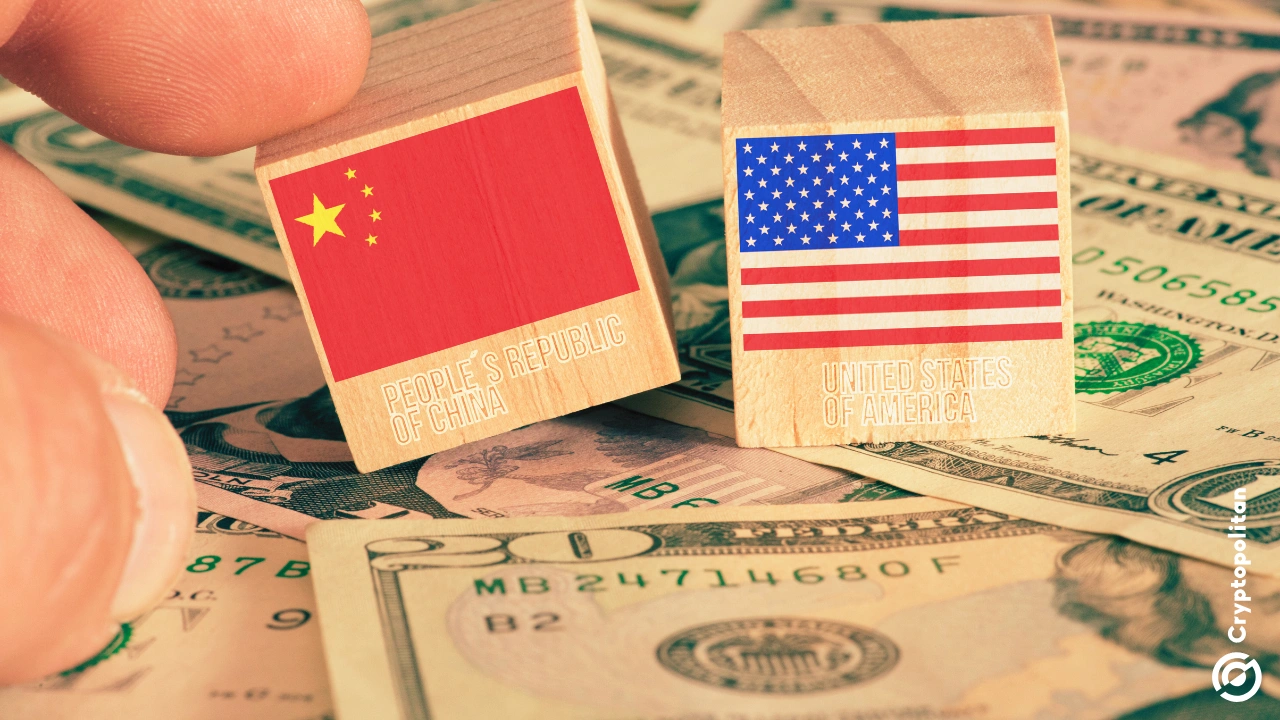


China’s Ministry of Commerce has told the United States to stop threatening to impose sanctions on Chinese artificial intelligence companies.
The ministry has warned that it will take “all necessary measures” to defend its interests if Washington acts against them.
Why did the U.S. sanction China’s AI?
A spokesperson for China’s Ministry of Commerce said the continuous sanction threats from the United States lack any factual or legal grounding and amount to what China calls “AI hegemony.”
Senior U.S. officials reportedly want to investigate Chinese labs over the alleged “distillation” of advanced American models and might sanction them on claims of intellectual-property theft.
The same spokesperson argues that several of the Chinese models shipped at roughly the same time as leading U.S. systems and already rank among the best in certain areas, including front-end coding. Innovation, the spokesperson added, belongs to no single country.
China’s sharpest point is that many U.S. AI firms have distilled Chinese models during research and training, according to the Ministry of Commerce. The ministry also noted that close to 200 U.S. startups have asked their own government not to cut off access to Chinese open-source models, arguing a cutoff would blunt their competitiveness, as Cryptopolitan reported.
A government spokesperson also previously dismissed the theft allegations, calling them an unfounded “smear” rooted in prejudice.
Beijing closed by suggesting both countries honor a consensus reached by the two nations’ leaders.
Why is the money moving to Chinese models?
Cryptopolitan reported that Chinese models now account for 46.4% of routed token traffic on OpenRouter, a platform that lets developers swap between systems, against 35.7% for US-built models. DeepSeek alone contributes 17.6% of that total as of July 2026. A Hugging Face study published March 16, 2026, found Chinese open-source models made up 41% of all open-source model downloads.
The reasons for this massive adoption of Chinese technology are that its compute runs far cheaper, and the U.S. export limits that were imposed earlier in 2026 on frontier models such as Anthropic’s Claude Mythos 5 and Fable 5 created openings that foreign systems filled.
Following Moonshot AI’s launch of Kimi K3 and developers’ claims that the model’s performance is close to Anthropic’s Fable and OpenAI’s ChatGPT, offered at a far lower price, the U.S. has been considering new measures against Chinese technology.
OpenAI’s most recent valuation stood at $852 billion and Anthropic’s at $965 billion, against a reported roughly $30 billion for Moonshot.
Cryptopolitan reported July 20 that the U.S. is likely to impose new procurement rules, renew its threats to add Chinese labs to the Commerce Department’s Entity List, and apply public pressure on American companies that use Chinese models. The Entity List already restricts hundreds of Chinese firms from buying U.S. goods without a license.
If you’re reading this, you’re already ahead. Stay there with our newsletter.



Read More