

Massive names have recently shipped wallets built for AI agents. Metamask announced its AI agent wallet just last week and Coinbase has been running one since February. The infrastructure is well and truly here, working and processing millions of transactions. We ran a poll on whether our readers would actually use it.
What Has Actually Changed In the Past Six Months
If we look back to a year ago, the thought of an AI agent being able to control and move your crypto around on its own felt farfetched. That shift happened faster than most people in the industry gave it credit for and it’s worth pausing on some of the developments that have come into existence.
The most recent news came from MetaMask. On June 8, the Consensys-owned wallet provider that burst onto the scene in 2016, opened early access to Agent Wallet. This is a self-custodial wallet purpose-built for AI agents to execute trades and DeFi interactions on their own. The product gives access to swaps, perpetual futures, prediction markets and liquidity provision across nine EVM chains and Hyperliquid. The user of the wallet keeps their keys and can set pre-defined rules or set of instructions for the agent to follow. This includes daily spend limits, allowlisted protocols, mandatory 2FA on anything outside the rules. MetaMask also highlighted the security side of things in their press release stating that every transaction would be threat-scanned and that any transaction that is deemed safe is guaranteed a $10,000 coverage.
That said, MetaMask is by no means the only one here nor are they the first. Coinbase launched Agentic Wallets back in February this year, billed as the first wallet infrastructure built from the ground up for non-human operators. The Coinbase product runs on x402, a payments protocol the company built specifically for machine-to-machine transactions, and the keys themselves sit inside hardware-isolated Trusted Execution Environments so the agent never actually touches them. As of June 2026, the x402 protocol has crossed 480,000 active agents and processed over 165 million transactions worth more than $50 million in cumulative volume. Over the past three months, there has been a noticeable up trend in total weekly transactions from around 548K to 2 million. That is around a 265% increase in weekly transactions since March.
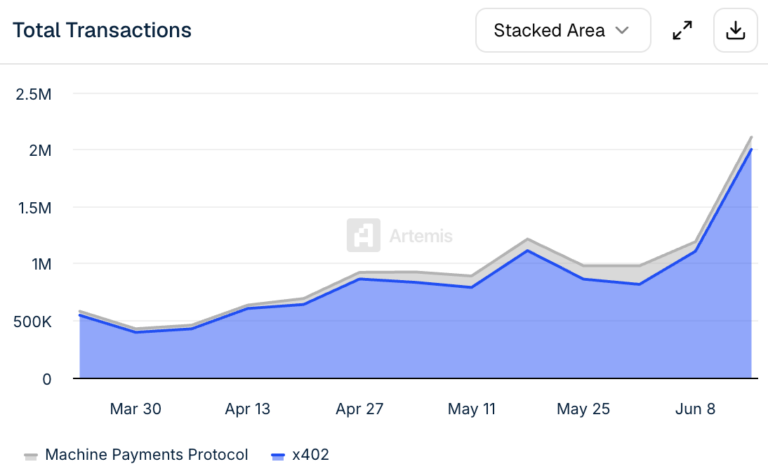
Source: Artemis
MoonPay integrated Ledger wallets for AI transactions and rolled out the Open Wallet Standard with backing from PayPal and the Ethereum Foundation. Cobo shipped its Agentic Wallet earlier this year using MPC security. The x402 Foundation, which sits under the Linux Foundation, now counts Google, Visa, AWS, Circle, Anthropic, Stripe, Cloudflare, and the Solana Foundation among its backers. This is no longer reserved for just the crypto corner of the world. It is becoming basic plumbing for what Coinbase CEO Brian Armstrong has started calling “the agentic economy”, something that could potentially be even bigger than the human economy.
What These Wallets Let An Agent Do
An AI agent that has access to control crypto wallets can essentially keep tabs on on-chain conditions through the day, place a swap when a specific price target hits, routes through the cheapest DEX, take a position on a perp exchange, provide liquidity to a pool, close a position, claim rewards and even rebalance. All of this can be done overnight, while you’re not on tradingview, across multiple chains. The MetaMask product also opens up prediction markets, which is its own can of worms, agents trading on Polymarket-style events at speeds no human can match.
The pitch or idea behind the capabilities and utility of Agentic wallets is actually very simple to understand. Crypto is a 24/7 market and humans simply cannot function as 24/7 traders. Agents can help in closing that gap. The catch that the industry is grappling with at the moment is what happens when the agent gets it wrong and hallucinates or when it’s hacked?
That is exactly why the question we raised in our newsletter is so pertinent in today’s world: do you trust this enough to let it touch your money?
Poll Result: A Split Down The Middle, And A Trust Problem In Plain Sight
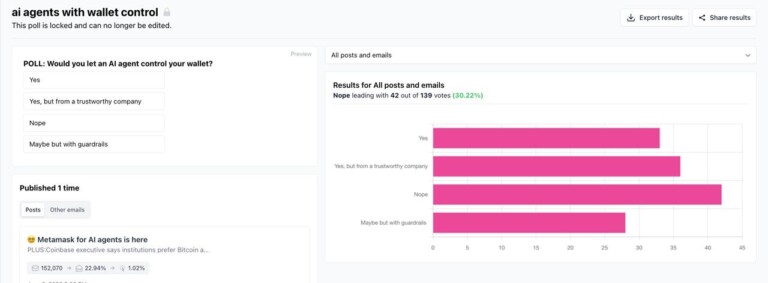
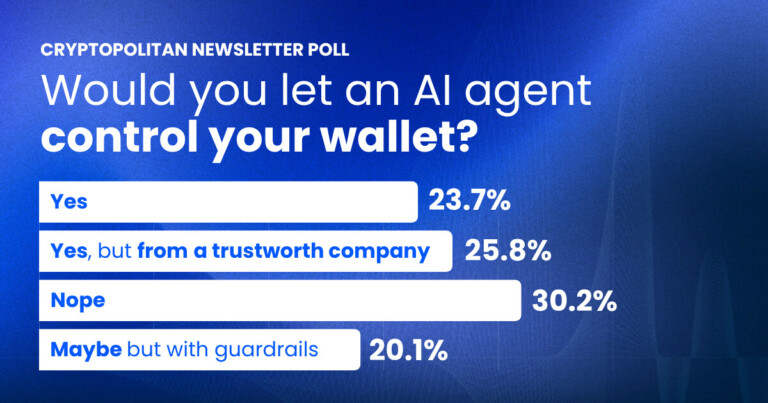
These are readers who hold crypto positions, run DeFi strategies, follow protocol launches, and in many cases have spent years getting comfortable with self-custody. Asking this group whether they would let software move their money is a more loaded question than it might sound. The fact that no single option pulled away from the others is the first aspect worth flagging. This is not a community that has made up its mind.
Nope (30.22%): The leading response, and the one most aligned with crypto’s original instincts. Nearly a third of readers want nothing to do with handing wallet control to an agent, full stop. The instinct here is not technophobic. It is custodial. If the whole point of crypto was to remove intermediaries, plugging an autonomous third party into the signing flow is a step in the wrong direction philosophically, even if the agent never actually holds the keys. This cohort is drawing the line where many in the space have always drawn it: my keys, my coins, my decisions.
Yes, but from a trustworthy company (~25.9%): The second largest response and probably the most revealing. About one in four readers are not opposed to the idea, they just want a brand behind it. Translated, this is the MetaMask/Coinbase vote. The user is willing to hand off execution provided the rails come from somewhere with skin in the game and a public reputation to protect. This is also the response that explains why MetaMask put $10,000 in transaction insurance on the launch and why Coinbase built TEE isolation into Agentic Wallets from day one. The companies are reading the same sentiment we are seeing in our poll.
Yes (~23.7%): Around a quarter of readers are part of the early-adopter cohort, the people who already potentially run bots, automate strategies and probably already have an agent doing something on-chain that the rest of us have not got around to setting up yet. Worth noting how close this group is in size to the unconditional “Nope” cohort. The community is genuinely split, not leaning one way and pulling the other along, but actually divided.
Maybe but with guardrails (~20.1%): One in five readers are open to it but want the safety rails first. This is the wait-and-see vote, and it lines up almost exactly with the design philosophy MetaMask and Coinbase have both built around. Spending caps, protocol allowlists, simulation checks, 2FA on flagged transactions, insurance backstops. This cohort wants exactly what the products are now offering. Which raises an interesting question: does this group move into the “Yes” column once they actually try the new products, or does the friction of setup keep them on the sidelines longer than the industry would like?
Add the “Yes” and “Yes with a trusted brand” and “Maybe with guardrails” responses together and you get just under 70% of readers open to agent-controlled wallets in some form. That is a notable number. It says the resistance is not really to the idea itself, it is to the execution, the brand and the trust model. Get those right and most of this audience comes along.
The Bigger Picture
Today there is a shift that is taking place that goes beyond crypto-native users. If Gartner’s projection holds and 40% of enterprise applications embed AI agents by the end of 2026, the question of how those agents pay for things stops being a niche concern. It becomes infrastructure. Visa, Stripe, Google, AWS, and Anthropic did not join the x402 Foundation because they think this is a crypto sideshow. They joined because the future they are building toward includes machines paying machines and the rails that can handle that at scale do not exist anywhere else right now.
The 30% of our readers saying “Nope” today are responding to a product question. The 70% saying yes in some form are responding to where they think this is going. Both are reasonable positions to hold in June 2026. Neither is the final answer. The agents are here, the wallets are shipping, and the only thing still being negotiated is the trust model. That is the actual story underneath this poll, and it is the one worth watching for the rest of the year.
The smartest crypto minds already read our newsletter. Want in? Join them.



Read More