

The DeFi Yield Problem — Complexity, Hidden Fees, and Unsustainable Rewards
Decentralized protocols allow practically limitless access across multiple platforms. This opens a series of problems both at the level of individual users and industry-wide. The main problem is how to manage liquidity positions on multiple protocols, while carrying out complex strategies and mitigating both market and technical risk.
Opportunities on decentralized platforms shifted multiple times, with several major approaches. Some platforms paid out rewards in their native tokens, ending up with a short-term activity spike and a crash. Liquidity providers participated just enough to gain the new tokens and sell as fast as possible while the hype lasted.
Earlier DeFi and DEX platforms also showed instability and significant trading slippage, using the earliest tools for automated price discovery based on liquidity pools.
Activities like yield farming are changing at a fast pace. Many rely on temporary token emissions and inflated yields, which can collapse without warning or when incentives like point farming end. Discovering the best yields may be time-consuming and overwhelming.
Additionally, DeFi activity can have hidden fees, impermanent loss, and smaller-than-expected rewards, which diminish real returns. The industry is hard enough for advanced traders, but it may require a steep learning curve for beginners, often accompanied by losses.
To address those issues, Cyrus Finance designed a trading strategy mitigating all these pain points. The platform aims to answer the main question of selecting the best DeFi yield protocol in 2026. We will address how Cyrus Finance solves several issues inherent to DeFi, as well as crypto market volatility, by implementing a platform based on the best Web3 practices.
What Is Cyrus Finance?
In this Cyrus Finance review, we will go over the solutions to DeFi problems, resulting in a balanced portfolio with sustainable returns.
Cyrus Finance is a next-generation multi-platform DeFi ecosystem built on an advanced curve trading model, using AMM V3 optimization. The V3 upgrades, introduced first by the Uniswap exchange, spread across the crypto ecosystem. V3 protocols created their own solutions for concentrated liquidity, repairing the erratic trading of the simple AMM liquidity curve.
The platform’s main mission is to maximize capital efficiency through optimized liquidity and dynamic fee distribution. Cyrus Finance already has a live and operational DeFi product, designed for both advanced traders and beginners. Traders and users can allocate funds with reassurance their investment will produce optimal fees and support active trading.
Cyrus Finance automates the investment process, simplifying the research for the best yield across multiple protocols. At all points of investment, participants are in full control of their assets.
All Cyrus Finance DeFi activities are governed by smart contracts, audited by Certik, and fully transparent on-chain. The system is entirely decentralized, with no intermediaries that can introduce hidden fees. The aggregated yield protocols also allow all Cyrus Finance users to avoid exposure to unverified DeFi apps or malicious protocols.
Cyrus Finance uses its proprietary liquidity algorithms with leading third-party protocols to generate the best and most sustainable yields. All operations are open-source and transparent, undergoing detailed professional audits.
Dynamic Fee Distribution and Algorithmic Liquidity Optimization
Cyrus Finance builds upon the idea of implementing concentrated liquidity, with a view to optimizing trader experience and yield. Several DeFi protocols tested concentrated liquidity over time, to the benefit of liquidity providers (LPs). In the original DeFi trading model, the automated market maker contract allowed LPs to provide liquidity at any price.
Assets were usually traded within a more predictable range, and having liquidity in that range prevented slippage. DeFi protocol stability is a key factor for crypto adoption, as demand for permissionless trading is still significant. Traders are more selective in 2026, seeking Web3 protocols that are sustainable and offer predictable returns.
Cyrus taps PancakeSwap liquidity pairs as its main yield generator. The protocol allocates funds strategically, while end users need to only provide one-sided liquidity in USDT. This prevents the complexity of holding and tracking multiple tokens.
Early LP farming has shown volatility, especially if the rewards are paid out in newly minted tokens. Cyrus Finance is designed to smooth out returns, offering a predictable fixed yield. Users are not exposed to complex DeFi mechanics, but receive predictable rewards reflecting activity and ecosystem growth.
Just like the first liquidity pools, LPs deposit tokens to a pool, expecting rewards for taking the risk of impermanent loss. Cyrus Finance, however, uses a concentrated liquidity formula to improve market depth and mitigate risk.
In concentrated liquidity models like the Cyrus Finance AMM V3, LPs provide liquidity within a specific price range. Capital efficiency with concentrated liquidity can be higher by a factor of 200 or 300, meaning LPs can receive higher fees, while traders are assured of limited slippage. For instance, a range of several hundred USD for ETH trading will generate higher fees compared to providing liquidity for all price ranges.
This allows LPs to receive more fees, while traders operate with much lower slippage. Revenue is generated through trading fees captured from AMM V3 liquidity positions. Strategies are presented ahead of time, with a transparent fixed expected yield and time duration. There are no unpredictable moments with Cyrus Finance, and no decision-making on abandoning a position, as traders can pick their preferred time horizon.
Cyrus Finance also built a mechanism of dynamic fee distribution. The platform adjusts transaction fees based on market conditions, available liquidity and trading activity. LPs thus receive increased fees during periods of high volatility, so they can be compensated for the risk and cut some of their impermanent loss. LPs do not receive a static percentage, allowing them to achieve the best yield under any market conditions.
Cyrus Finance also uses algorithmic liquidity optimization, rebalancing positions for maximum capital efficiency. Users do not need to manually adjust positions or look for the best time to enter the market, the protocol will handle optimization automatically.
All earnings are adjusted and generated based on the Cyrus Finance algorithm. The protocol is not entirely autonomous, but instead manages liquidity positions based on several predetermined strategies, in order to capture the best available fees. There are no requirements for hidden conditions or complex setups to ensure earnings.
Cyrus Finance also does not rely on artificial incentives such as point farming. Those temporary rewards or inflated token emissions lead to short-term gains, but often result in reputational damage for the protocol and losses for users. Cyrus Finance ensures that LP revenue comes from real trades, fee capture, and optimized liquidity conditions. The protocol achieves stable and sustainable yield, instead of gains from a short-lived incentive program.
Multi-Pool Management — Diversified Exposure Across Top Assets
Cyrus Finance pools support multiple asset pairs, giving LPs diversified exposure to different tokens and ecosystems. Each pool reflects a different market dynamic, allowing traders to tailor their strategies.
The CAKE/USDT pool is based on PancakeSwap trading, reflecting the performance of one of the most active decentralized markets.
The ETH/USDT pool serves as a blue-chip pair, tracking the token that reflects both crypto sentiment in general, and the state of DeFi.
The DOGE/USDT pair brings high volume trading to a meme asset pair, with a mix of legacy trading and new meme hype.
The platform also offers BTC/USDT and USDT/USDC liquidity pools. Stablecoin pools are of key importance during high-volatility periods.
Users and LPs can thus get optimized returns across multiple crypto asset pairs, without managing each position separately. The LPs are not exposed to a single-pari risk, and instead gain from different token dynamics, including utility, meme hype, and blue-chip stability.
Cyrus Finance has selected a limited number of pools to simplify decision-making. Users can watch their yield in real time, choosing either to withdraw or compound it.
Security and Transparency — Fully On-Chain, Fully Audited
All positions and LP rewards are fully visible on-chain and verifiable by anyone. Cyrus Finance also offers convenient tracking and analytics based on the blockchain data. The DeFi platform uses BNB Chain, an agile and low-fee venue for trading. BNB Chain is time-tested and has become a leading venue for DEX activity.
To ensure safety, Cyrus Finance completed an audit of all its smart contracts by CertiK, one of the leaders of DeFi contract security. The audit was completed in November 2025. All the open-source contracts of Cyrus are also available on GitHub for independent preview.
None of the processes on Cyrus happen off-chain, or rely on a back-end process. All events can be visualized through public block explorers.
Cyrus Finance has published all its contracts transparently on BNB Chain. The Vault Contract is the protocol’s core, responsible for distributing funds to third-party DeFi protocols.
Cyrus Position NFT presents a permanent on-chain record of every deposit, wrapped as a unique token that reflects a user’s share in vaults. This makes positions transparent, verifiable and even tradable to other participants.
The Treasury Contract collects all generated rewards, distributes yield, and securely tracks the shares for each depositor.
How Cyrus Finance Works — Step by Step
Cyrus Finance allows access to all users with a crypto wallet. We will walk through the process of using the platform for optimized yield.
- Connect the wallet to the official Cyrus Finance link.
- Choose a strategy or a pool from the available pairs CAKE/USDT, ETH/USDT, DOGE/USDT, BTC/USDT, or the stablecoin pool USDT/USDC.
- Deposit funds to allocate to your chosen strategy.
- Earn automatically, as the protocol algorithm optimizes the position and distributes fees.
- Withdraw funds at any time without delays.
Cyrus Finance does not require a complex setup, and the interface is designed for users seeking yield without active management. Earnings are fully based on the AMM V3 positions and depend on the dynamic market conditions at any given time.
Users can also track their open and completed positions, and ask for a withdrawal at any moment.
Referral Program — Earn Additional Rewards Through Your Network
Cyrus Finance grows through a referral program, securing additional rewards for inviting more liquidity providers. The protocol’s referral system is also designed to reward community-driven growth. The program includes up to 20 levels of referral rewards, targeting all scales of DeFi users.
Levels are unlocked by maintaining an active deposit, ranging from $10 to $5,000 for the top level. Percentage rewards are diminishing, but overall rewards grow based on trading activity. Top-tier deposits can support up to $300K in trading.
All referral rewards are reflected on-chain for full transparency, and due rewards are distributed directly to wallets. There is no need for an additional claims process.
User Interface and Experience
Cyrus Finance can accommodate both beginner and experienced DeFi traders. The platform applies the best practives with an intuitive dashboard, visualising all personal contributions. The process is maximally simplified to invite new users, since growth is the main objective for Cyrus.
All users can track their active positions and pool allocations. Returns are available in real-time based on transparent yield metrics. Commissions and fee tracking are also automated.
Traders can also access their rewards from the referral program.
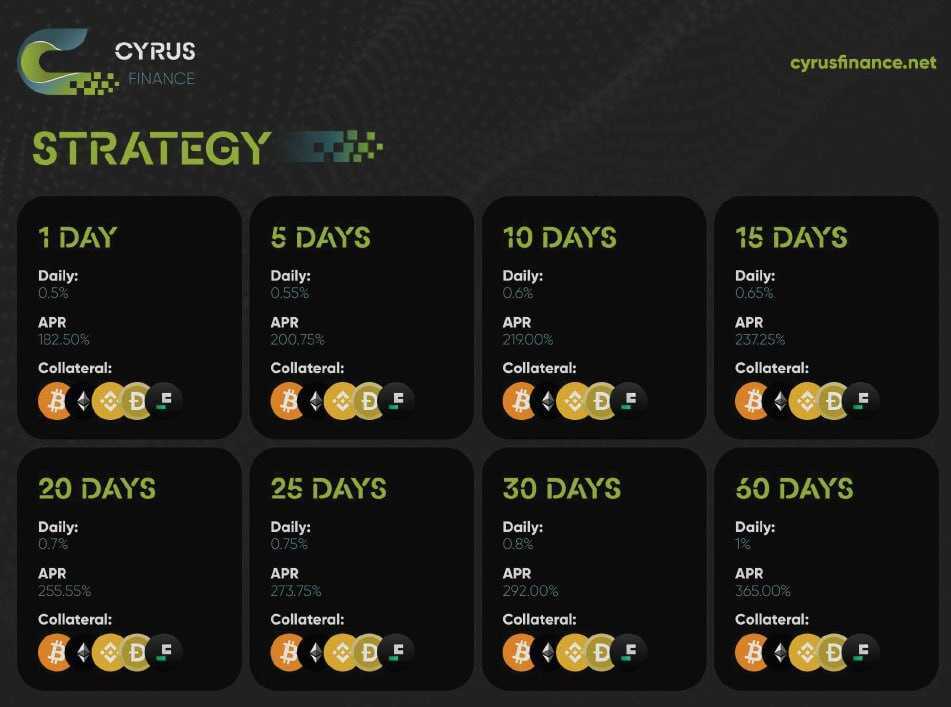
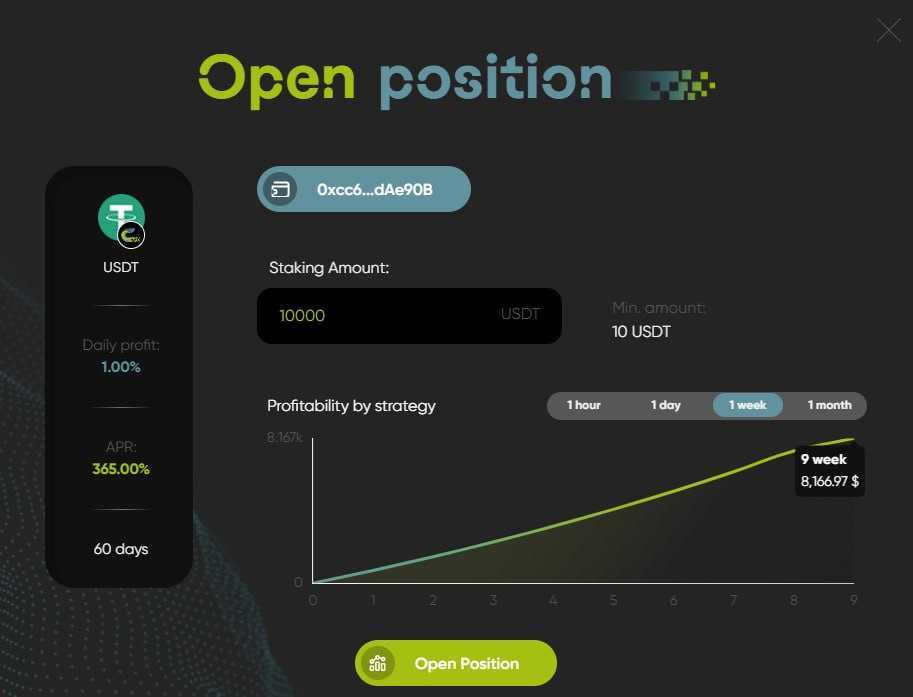
The dashboard allows Cyrus Finance users to re-evaluate their strategy. All available pools show their merits at a glance, with estimates of projected income.
Users can also fine-tune their choices, by visualising their individual strategy. The platform allows preview calculations of input amounts and expected yield, even before users commit their liquidity.
Who Is Cyrus Finance Best Suited For?
Cyrus Finance targets multiple groups of DeFi users with varied objectives. The protocol is suitable for active DeFi traders, who are looking at a more efficient multi-pool participation. The main advantage for those high-velocity traders is the automated liquidity management without manual rebalancing. Traders can preview the available pairs and choose the best yield, while relying on the algorithm to calculate the returns and rebalance positions.
The protocol also draws in yield-focused investors, who can use the algorithmic optimization instead of chasing point farming or temporary campaigns with rewards. Cyrus Finance offers several major strategies, each with its own liquidity profile.
Cyrus Finance is especially dedicated to yield-focused users, who want to track all positions on-chain and have access to in-depth analytics. The analytics dashboard is ideal for users who aim to track and optimize yield.
Last but not least, the platform is suitable for DeFi beginners who want to have a clear interface to manage positions or just access a referral program with minimal technical knowledge. The referral returns are transparent and always available for verification. Rewards will also accrue with no extra steps to claim, again not requiring technical knowledge.
Final Verdict
Cyrus Finance positions itself with the latest Web3 tools, focusing on wide adoption and sustainable yield. The platform’s liquidity structure and rewards focus on longevity, rather than campaign-based farming or issuing new tokens.
The proprietary AMM V3 tools ensure capital efficiency over older simple trading curve models. Liquidity is calculated in the most active range, optimizing for fees and market depth.
Cyrus offers multi-pool management across CAKE, ETH, and DOGE trading pairs. The assets were chosen as a diversification tool, reflecting trends in DEX trading, overall DeFi, as well as meme activity.
All smart contracts ensuring the fairness of pools have been audited by CertiK at the end of 2025, as a security baseline.
Cyrus has low barriers to entry for DeFi newcomers, and offers the biggest percentage rewards for retail traders. The protocol’s user-friendly interface and automation make it suitable for DeFi beginners.
As with other DeFi protocols, allocating liquidity still requires users to do their own research and understand the risks. Cyrus tried to mitigate the negatives, but market volatility and smart contract risk must not be dismissed. Overall, the verdict on Cyrus is that the protocol has taken the best and well-tested elements of Web3, turning them into a product suitable for all investment levels.




Read More