

Decentralized exchange Hyperliquid delivered $215 million in gross revenue during Q1 2026 — crypto’s worst quarter since the 2018 ICO crash — outperformed Bitcoin by 71.5 percentage points, and on one February night, became the de facto global price discovery venue for crude oil while every legacy commodity exchange was closed.
The findings come from a comprehensive 48-page quarterly report published by the Hyperliquid Research Collective (HRC), a joint initiative of Four Pillars and GLC Research, drawing on on-chain data from ASXN, DeFiLlama, and 0xArchive.
The quarter unfolded as Bitcoin fell 26.7% and total crypto market capitalization shed roughly $900 billion. Hyperliquid’s headline metrics declined with the market — holder revenue dropped 33.6% quarter-over-quarter to $149.90 million and perpetual derivatives volume fell 15.6%. Those numbers, the report argues, are not the story.
The Night Hyperliquid Became The Oil Market
On February 28, following US-Israeli strikes on Iran, traditional commodity exchanges went dark. Hyperliquid’s 24/7 oil perpetual derivatives markets stayed open. The protocol became what the report describes as the de facto price discovery venue for crude oil while legacy infrastructure sat offline — an event that drew coverage from Bloomberg, the Wall Street Journal, and Fortune within a five-day window, according to the report.
That single session, the HRC notes, said more about Hyperliquid’s institutional trajectory than any quarterly metric.
The Number That Matters: HIP-3
Beneath the headline revenue decline, a structural transformation was underway. Native crypto perpetual derivatives volume fell 32.5% as risk appetite contracted. HIP-3 deployer volume — a protocol feature enabling third parties to deploy real-world asset (RWA) perpetual derivatives on Hyperliquid’s infrastructure — moved in the opposite direction entirely, growing from $24.9 billion in January to $68.5 billion in March, a 175% intra-quarter expansion, per ASXN data cited in the report.
By March, HIP-3 represented 33.6% of total daily perpetual derivatives volume and 28.7% of total platform open interest. Daily unique HIP-3 traders tripled within the quarter, reaching 40,768 on the final day. Silver was the single most traded asset at $40.7 billion in Q1 volume, exceeding crude oil by approximately 2.4x.
The quarter’s institutional landmark arrived on March 18, when S&P Dow Jones Indices officially licensed its S&P 500 benchmark to Trade[XYZ] for perpetual contracts on Hyperliquid — the first officially sanctioned equity index perpetual derivatives product on a decentralized exchange. The contract reached $2 billion in volume within its first two weeks, according to the report.
The Supply Side Signal
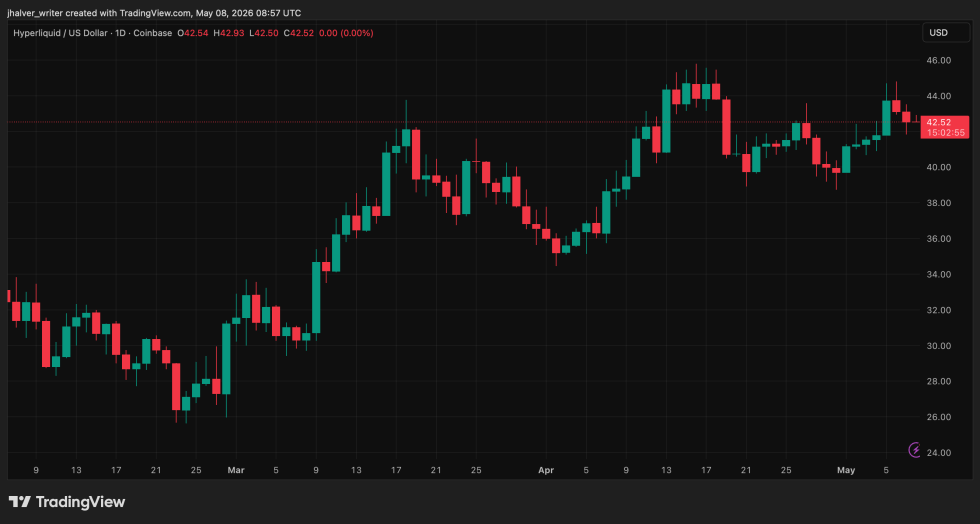
On the token side, Hyperliquid’s Assistance Fund purchased approximately 4.94 million HYPE at an average price of $29.90 during Q1 — 18.8% below the quarter-end price of $36.85 — deploying $147.72 million into buybacks. HYPE itself returned +44.8% for the quarter, per CoinGecko data cited in the report.
The report flags an additional signal that it describes as a character disclosure rather than a financial metric. The protocol’s core team claimed just 1.51 million HYPE against a scheduled entitlement of approximately 29.8 million — a 5.1% claim rate, declining each month throughout the quarter. At average Q1 prices, the team voluntarily left approximately $849 million unclaimed.
Four separate ETF filings for HYPE — from Grayscale, VanEck, 21Shares, and Bitwise — were submitted during the quarter, per the report.
The Worst Crypto Quarter Since 2018
The report does not sidestep the primary constraint: US persons cannot access Hyperliquid’s frontend. Every revenue figure, every volume number, and every user count in the report reflects a protocol generating these results without US market participation. The HRC frames every forward valuation of HYPE as, in part, a thesis on whether that regulatory wall eventually comes down.
The Q1 2026 report marks a critical juncture for Hyperliquid’s positioning within the nascent sector. A decentralized exchange that processed live commodity trades while legacy markets were closed, licensed the S&P 500 for on-chain derivatives, and outperformed Bitcoin by 71 percentage points in the worst crypto quarter in eight years is no longer a DeFi story. It is increasingly a financial infrastructure story — and the institutions are beginning to take notice.
On the above, David Schamis, CEO at Hyperliquid Strategies stated the following:
For a year I’ve been saying Hyperliquid is emerging as the most exciting trading venue, period. Q1 settled the argument. One of the worst crypto quarters since 2018 and the protocol still generated more than $200M in revenue, bought back >5M HYPE, brought the S&P 500 onto a decentralized exchange and became the price of oil when legacy markets were closed for the Iran conflict. This isn’ t a future story anymore — it’s all happening now.
Cover image from Grok, BTCUSD chart on Tradingview
The post Hyperliquid Outperformed Bitcoin By 71% In The Worst Crypto Quarter Since 2018 — Report Reveals Why appeared first on Bitcoinist.




Read More