

The post Oil Hits $100 as War Risks Rise—Where Are Investors Moving: Gold or Bitcoin? appeared first on Coinpedia Fintech News
Global markets are once again reacting to rising energy prices as Brent Crude Oil moves higher amid geopolitical tensions and supply concerns. Historically, sudden spikes in oil prices have often appeared during periods of global uncertainty, forcing investors to reconsider where they allocate capital.
A similar situation was seen in November 2022, when oil prices surged above $100 per barrel. That period coincided with the bottom of the 2022 crypto bear market, which also saw extremely high trading volumes across digital assets. The surge in energy prices reflected broader macro stress across global markets.
Now, with oil prices once again showing strength, investors are closely watching how different asset classes react to the renewed uncertainty, specifically the Bitcoin (BTC) price.
How Is This Impacting Stocks & Gold?
Rising oil prices are once again creating volatility across traditional financial markets. When crude approaches the $100 per barrel level, investors typically become cautious toward equities as higher energy costs increase production and transportation expenses for companies. Major indices such as the S&P 500 are currently trading near 5,100, while the NASDAQ Composite is hovering around 16,000, both showing increased sensitivity to macroeconomic developments and geopolitical risks.
At the same time, precious metals are witnessing strong investor demand. Gold has been trading around $5,000–$5,150 per ounce in recent sessions after reaching record highs earlier this year. Meanwhile, Silver has also surged significantly, trading roughly in the $85–$100 per ounce range as investors look for defensive assets during periods of global uncertainty. Precious metals often benefit during such macro conditions, as they are widely considered reliable stores of value when inflation risks and geopolitical tensions rise.
Will Rising Oil Prices Push the BTC Price Lower?
Recent market trends suggest that broader macroeconomic shifts could again start influencing the crypto market. Historically, movements in energy markets—especially crude oil—have often coincided with major turning points in Bitcoin’s price cycle.
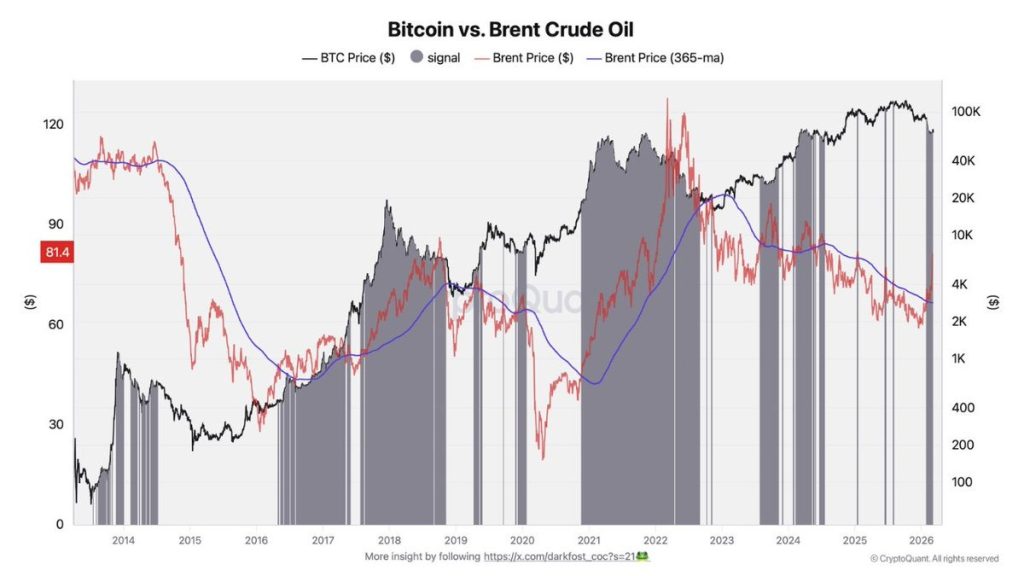
As seen in the chart above, several periods of declining oil prices, particularly around 2015, 2020, and after the 2022 peak, were followed by strong upward moves in Bitcoin. This pattern suggests that changes in energy markets may reflect wider shifts in global liquidity and economic sentiment, which eventually impact risk assets like Bitcoin.
While oil prices do not directly determine Bitcoin’s movement, the chart provides supporting evidence that macro trends in energy markets can act as an early signal of changing conditions that may influence Bitcoin’s next phase.
The Final Verdict
With oil prices approaching the $100 per barrel mark, market volatility across asset classes is likely to remain elevated. If risk sentiment weakens further, major indices like the S&P 500 could face pressure below the 5,000 level, while defensive assets may continue attracting capital. In such a scenario, gold could remain supported above the $2,100 zone, with silver holding above $24–$25, as investors look for stability during geopolitical uncertainty.
For Bitcoin, the key levels to watch remain around $60,000 on the downside and $70,000 on the upside. A sustained break below $60,000 could trigger further selling pressure as liquidity tightens, while a move above $70,000 may signal renewed bullish momentum. As oil-driven macro uncertainty rises, Bitcoin’s price action around these levels could reveal whether investors continue treating it as a risk asset or begin positioning it as an alternative hedge.
The post Oil Hits $100 as War Risks Rise—Where Are Investors Moving: Gold or Bitcoin? appeared first on Coinpedia.org.



Read More