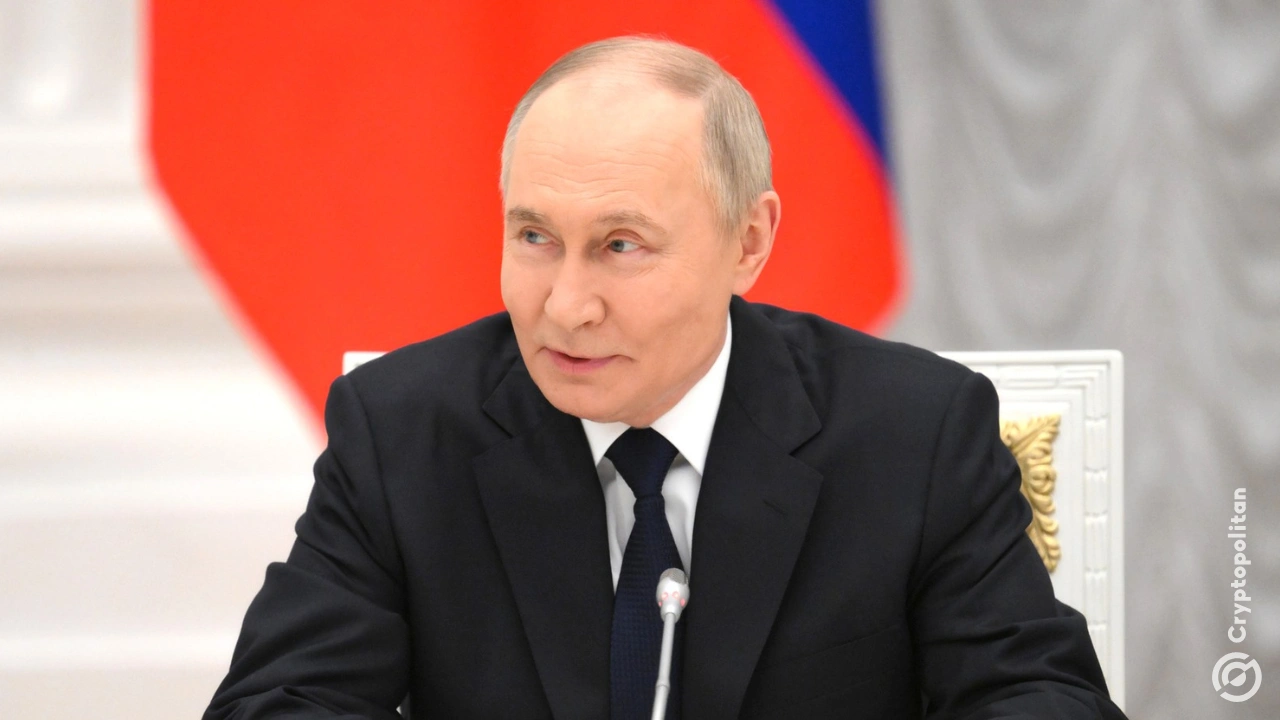


Russian President Vladimir Putin has signed into law the recently adopted “digital currency” bill that legalizes crypto transactions in his country.
The long-awaited legislation, which establishes Russia’s first comprehensive regulatory framework for digital assets, will enter into force in September.
Putin gives the go-ahead to Russia’s crypto regulations
Russia’s head of state has signed the law “On Digital Currency and Digital Rights,” greenlighting Moscow’s main attempt to thoroughly regulate operations with cryptocurrencies.
The nearly 300-page document, which passed through both houses of parliament last month, is now available on the Russian government’s official portal for legal acts, local media reported on Tuesday.
The bill was submitted in April, when lawmakers voted on the proposal for the first time, before it was finally adopted by the State Duma on July 21 and approved by the Federation Council on the 24th.
While the initial plan was to introduce the law earlier in the summer, it will now come into force on September 1, 2026, following a delay caused by the need to fine-tune some of its provisions.
The massive package legalizes and regulates key cryptocurrency transactions in Russia, like those related to investment and trading, while banning others, such as direct crypto payments.
It imposes rules for investors and a number of market participants, including dedicated platforms and traditional financial institutions that will be permitted to work with digital assets.
Among them, established stock exchanges and exchange offices offering basic non-cash crypto-fiat conversion, custodians and clearing houses, as well as banks and various intermediaries.
In accordance with its articles, the trading of digital coins will be conducted exclusively through platforms duly licensed by the Central Bank of Russia (CBR).
A new category of service providers called digital depositories and existing stock market depositories will be responsible for the safekeeping and accounting of crypto holdings.
The latter must be registered with the monetary authority and meet strict capital requirements ranging between 50 million and 250 million rubles (over $3 million), depending on their activities.
These custodial platforms will be obligated to keep full transaction records and screen their clients’ transfers to detect any suspicious movement of funds in the digital space.
Financial brokers and capital management firms will act as intermediaries between Russian investors and cryptocurrency platforms, including entities that are based abroad.
Most Russians to gain limited access to cryptocurrencies
Perhaps the biggest change that the law brings concerns crypto users in Russia. For the first time, they will be able to legally acquire and own Bitcoin and the like, although not without restrictions.
While all investors will have to undergo testing to determine their sufficient knowledge of these assets and the associated risks, access will be limited for non-professional participants.
Ordinary citizens, or “non-qualified investors,” will be permitted to purchase only a few of the biggest cryptocurrencies on the market today, Russian business and crypto news outlets reminded readers.
They will be allowed to buy no more than 300,000 rubles’ worth of crypto a year (less than $4,000) through a single intermediary, RBC and Bits.media highlighted in their reports on the matter.
For most people in Russia, cryptocurrency will be mainly an investment instrument, as its use for payments has been strictly prohibited, and the ruble remains the only legal tender.
A survey, the results of which were published this week, showed that nearly 70% of Russians see no significant use cases for cryptocurrency despite its upcoming legalization.
No other than purely custodial wallets opened with authorized institutions can be used to receive, store and send digital money inside the Russian Federation.
Self-hosted wallets can be used by those involved in foreign economic activities, which will allow them to trade internationally and bypass fiat sanctions. Their use abroad will not be restricted.
Banks to be able to block crypto transactions
Russian banks will be authorized to block any crypto-related transaction, and a 48-hour “cooling-off” rule will apply to transfers between cryptocurrency wallets and from them to fiat accounts.
Only the coins with the largest market capitalization, liquidity and long enough pricing history will be allowed to freely circulate through exchanges active in Russia’s regulated crypto market.
According to an earlier statement by the CBR’s Deputy Governor Vladimir Chistyukhin, Bitcoin (BTC), Ethereum (ETH) and Tether’s USDT currently meet these criteria.
The legislation does not explicitly mention stablecoins, but supplements the existing Russian law “On Digital Financial Assets” from 2021, which covers tokenized securities and coins issued in the country.
After July 1, 2027, cryptocurrency transactions carried out by Russian residents and firms must be conducted exclusively through licensed intermediaries.
Additional regulations will be needed and the Bank of Russia already published draft directives detailing specific rules for crypto exchange, storage and margin trading.
Don’t just read crypto news. Understand it. Subscribe to our newsletter. It’s free.




Read More