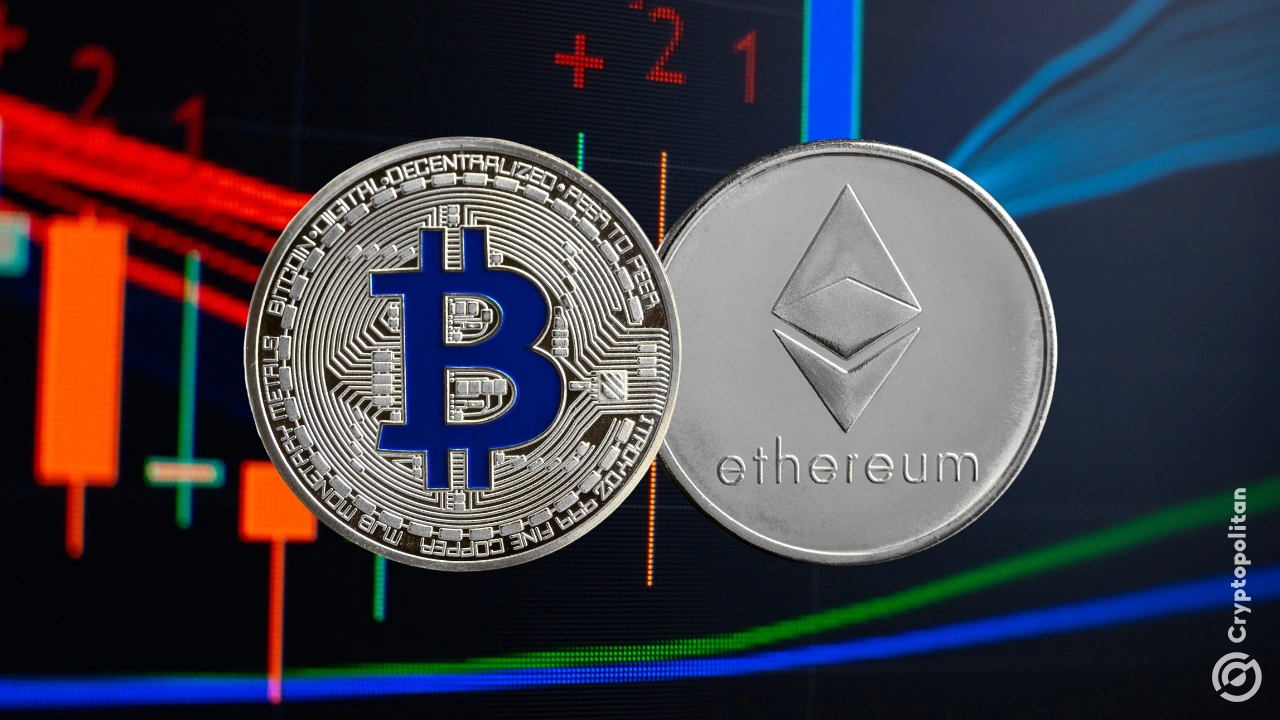


Crypto exchange Gate released its Private Wealth Management Report for May 2026. The report suggests that quantitative trading approaches were profitable despite the decline of Bitcoin and Ether in the face of geopolitical risks. This happened when the stablecoin regulation was approaching reality in the US.
The report matters for crypto market participants tracking how institutional products weathered a month where digital assets lagged traditional risk assets by a wide margin. Bitcoin dropped roughly 2.9% in May, and Ether fell more than 11%, according to Gate Research. US equities reportedly extended their rally, with the S&P 500 posting nine consecutive weekly gains through the end of the month, its longest streak since December 2023.
Quants delivered positive returns despite BTC, ETH losses
Gate’s private wealth division stated that 90% of its quant-based fund strategies posted profits in May. The notable performer in this list is the USDT-denominated hedging solution, Interstellar Hedging, where the asset managed to post a total profit of 18.6%, posting profits in all 23 measurement periods with a record-breaking win rate of 100%.
The stability of quant-based strategies in May has been quite similar to the performance of strategies in conventional financial markets. A quant-based strategy (short for quantitative) is an investment or trading approach that relies on mathematical models, statistical analysis, and computer algorithms to identify opportunities. Instead of using human intuition, gut feelings, or manual research, it uses automated, data-driven rules to make trading decisions.
According to reports, stock-picking hedge funds managed to yield a profit of 5.35% in May, higher than the gain from the MSCI Total Return Index, which stood at 4.55%. Other notable names like Citadel and Millennium Management were able to post profits in May as well. This suggests that systematic and market-neutral approaches continued to attract capital during periods of heightened geopolitical uncertainty and uneven risk appetite.
USDT strategy returns delivered an average return of 5.2%. The maximum drawdown experienced in both USDT and BTC strategies remained considerably lower than the fall in Bitcoin’s price during the same period, according to Gate.
In addition, traditional hedge funds performed well in May. Equity pickers posted gains of 5.35%, surpassing the gains recorded in the MSCI Total Return Index by 4.55%, according to Reuters, quoting Goldman Sachs. Meanwhile, multi-strategy funds managed by Citadel and Millennium Management generated returns of 1.43% and 2.4%, respectively.
The difference illustrates the risk-off approach prevalent in the cryptocurrency market for May. The tension between nations and reduced speculation resulted in the preference for the US equity market, especially tech stocks, while Bitcoin and Ethereum were affected by the selling pressure.
Regulating stablecoins moves towards implementation
Gate’s report also drew attention to another important issue for the market: the implementation of guidelines for the GENIUS Act is now underway, pushing stablecoin regulation from the legislative framework toward practical enforcement.
Reuters cited a study by Citi and Brookfield that showed that the circulation of stablecoins could grow by up to fifteen times by 2030. This report posited that the greatest gains might come from payment systems, custody services, compliance processes, and settlement systems, which underpin stablecoins.
This is indeed reflective of what is happening in the sector generally. Stablecoin circulation is reportedly expected to multiply by fifteen times by 2030. This could be attributed to the implementation of the GENIUS Act in 2025, which would provide clearer rules for stablecoin issuance and require stringent reserve requirements.
The introduction of payment stablecoins within the context of the GENIUS Act would alter the dynamics of how deposits move and create competition for the current payment systems, according to Deloitte in its report titled Banking and Capital Markets Outlook 2026. According to Deloitte, it will be crucial for banks to understand their responsibilities as far as issuance, custody, processing, or being partners in stablecoin offerings is concerned.
For cryptocurrencies, however, this can happen either way. On one hand, enforcement regulations can serve as an enticement to those institutions on the fence. On the other hand, they could result in higher compliance costs for issuers and exchanges within US jurisdictions.
The smartest crypto minds already read our newsletter. Want in? Join them.




Read More