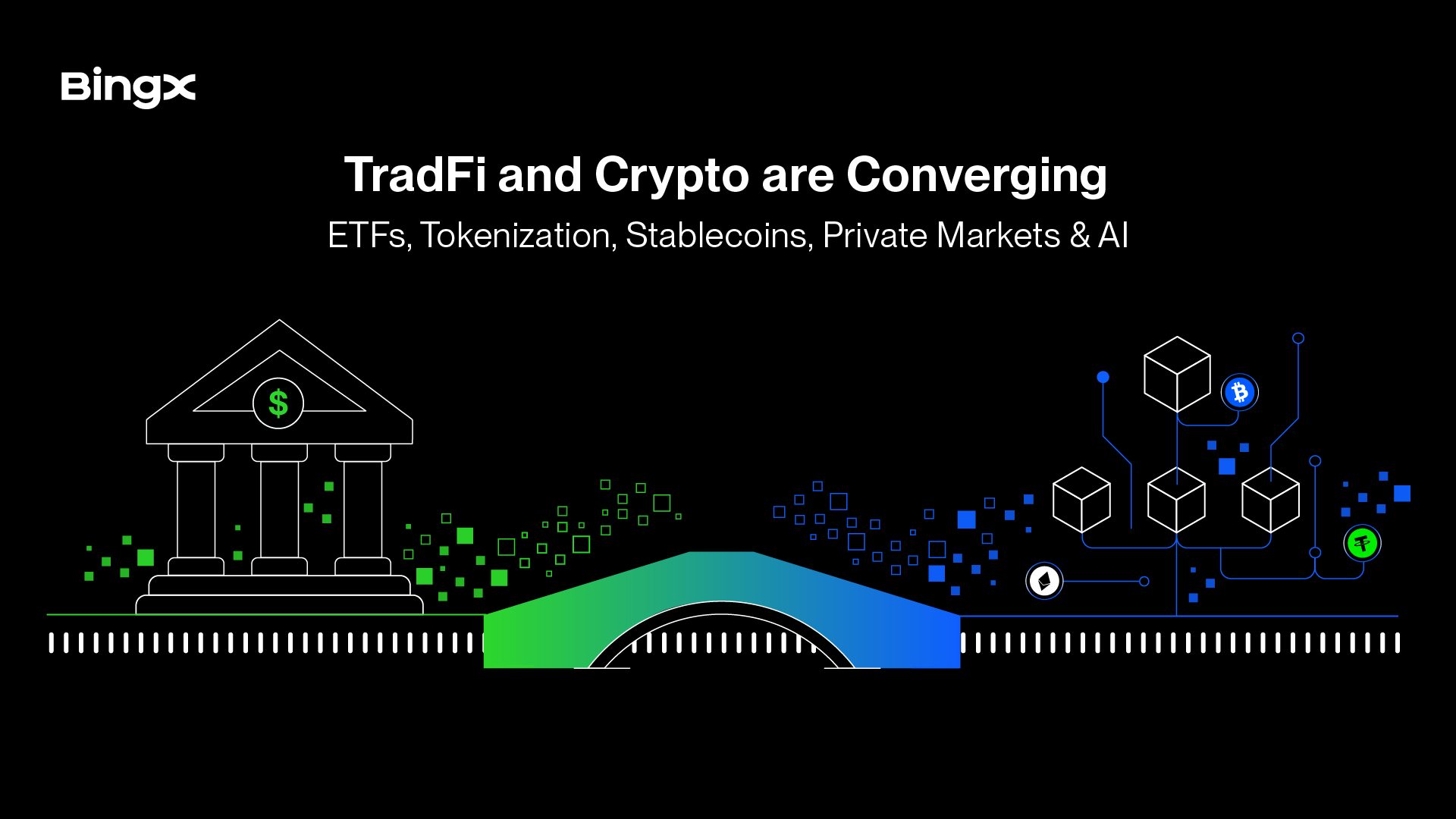


BingX Research has seen traditional finance and digital assets come together much faster over the past year. What used to be just talk about connecting two separate systems is now clear in fund flows, payment systems, collateral, and how people access private assets. The main question now is not if crypto will stay separate from traditional finance, but how quickly digital-asset systems will become part of the overall market.
There are now three main signs of this change. Spot bitcoin ETFs have made it easier for investors to add digital assets to their portfolios. Tokenized Treasury products have gone from being just ideas to being used as collateral by institutions. Major payment companies are buying, updating, and building stablecoin systems. All of this shows that traditional and digital assets are starting to work together, letting each side keep its own systems while still connecting.
The Institutional Signal: ETF Flows
The strongest sign from institutions is still the U.S. spot bitcoin ETF market. BlackRock’s iShares Bitcoin Trust ETF, IBIT, started in January 2024 and reached $63.5 billion in net assets by May 1, 2026, according to the fund’s iShares page (iShares). This is important because IBIT is not just for crypto experts. It gives digital-asset exposure in a format that traditional investors already know.
Flows reinforce the same point. IBIT attracted more than $25 billion of net inflows in 2025 after approximately $37 billion in 2024, bringing cumulative net inflows to around $62.5 billion since inception, with the total attributed to Farside Investors in market reporting (Yahoo Finance). BlackRock also placed IBIT among its major 2025 investment themes alongside short-term Treasurys and U.S. mega-cap technology exposure, according to the same report (Yahoo Finance).
This grouping matters because it moves digital-asset exposure from being a niche investment to a normal part of building a portfolio. When a big asset manager puts a bitcoin fund alongside Treasurys and top U.S. tech stocks, the conversation shifts from whether it belongs to how much to include, how to manage risk, and how to fit it in. Institutions may still debate things like volatility and timing, but digital assets are now part of the mainstream.
The Infrastructure Signal: Tokenization
The next big sign is tokenization, especially with tokenized U.S. Treasuries. BlackRock’s USD Institutional Digital Liquidity Fund, BUIDL, launched in March 2024 as their first tokenized fund on a public blockchain. It reached $1 billion in assets by March 2025 (PR Newswire). This fund gives qualified investors on-chain access to U.S. dollar yields, daily dividends, and almost instant peer-to-peer transfers, according to Securitize (PR Newswire).
By May 2026, RWA.xyz reported that the tokenized U.S. Treasury market was worth $15.20 billion, with BUIDL making up about $2.58 billion of that (RWA.xyz). While this is still small compared to the whole Treasury market, it is big enough to be important. Tokenized Treasuries are now more than just a story about faster settlements. They are being used as programmable collateral, on-chain cash tools, and reserves for other financial products.
BUIDL’s uses show how fast tokenization can go from launch to real-world use. Securitize said BUIDL helped with treasury management, stablecoin support, DeFi access, and trading collateral when it passed $1 billion in assets (PR Newswire). Later in 2025, Securitize said BUIDL would be accepted as off-exchange collateral for trading on a major digital-asset platform (PR Newswire). The main point is that tokenized government debt is now being used to make digital-asset markets more efficient.
The Payments Signal: Stablecoin Rails
The third sign is in payments. Stripe bought Bridge on February 4, 2025, for $1.1 billion to focus on stablecoin systems (CNBC). Bridge helps businesses handle stablecoin payments and cross-border transfers without needing to deal with all the technical details of digital tokens, according to CNBC (CNBC).
This deal was not just a one-off. Stablecoins handled $15.6 trillion in transactions in 2024, which is about the same as Visa, according to a16z’s fintech analysis (Andreessen Horowitz). At this level, stablecoins are more than just a way to settle crypto trades. They are now being considered for global payments, moving money between treasuries, and programmable settlements.
Stripe’s next move showed where things are heading. At the end of September 2025, Stripe launched Open Issuance from Bridge, a platform that lets businesses create and manage their own stablecoins (Stripe). Companies can choose which blockchains to use, set up smart contracts, and decide how to back their coins, all while connecting to a shared liquidity network, according to Stripe (Stripe). This marks a change from just accepting stablecoins as payment to making stablecoin creation part of business infrastructure.
The Next Frontier: Retail Access to Private Markets
The next stage of this trend will likely go beyond public assets and cash-like products. Private markets have usually been limited to wealthy investors, high fund minimums, and hard-to-trade secondary markets. For regular investors, this has meant missing out: many fast-growing companies only become widely available after they go public, by which time much of the value has already been created.
This is starting to change. Morningstar reported in April 2026 that retail investors could get pre-IPO exposure to OpenAI through ARK Invest ETFs as part of OpenAI’s funding round. The report also mentioned that public investors now have more ways to access private companies like Databricks, Stripe, and ElevenLabs through listed funds (Morningstar). It pointed out that companies like SpaceX and OpenAI have faced criticism for staying private longer, which has kept retail investors from sharing in big private-market gains (Morningstar).
Tokenized perpetual structures are another part of this change. They do not give direct equity ownership and come with risks like pricing, liquidity, and counterparty issues. Still, they show that it is now possible to get exposure before a company goes public. In 2026, this pre-IPO access is a major area where crypto and traditional markets are coming together.
The Operating Layer: AI in Retail Trading
As more assets become available, things get more complicated. Soon, retail investors might have access to stocks, indices, commodities, forex, crypto, perpetuals, tokenized Treasuries, and private-market products all in one place. But just having access is not enough if users cannot compare their investments or understand how they behave in tough markets.
This is where AI becomes the operating layer. Bloomberg reported in June 2025 that AI trading tools capable of analyzing large datasets and building portfolios were moving from Wall Street into retail-investor use cases (Bloomberg). The same report noted that retail investors own roughly 25% of the U.S. stock market directly and more than 60% indirectly through retirement accounts, based on Barclays calculations (Bloomberg).
In markets with many asset types, the real question for AI is not just if it can suggest trades. The bigger issue is whether it can help users make sense of complex markets by mapping exposures, running scenarios, tracking liquidity, sizing positions, and explaining risks. Over the next two years, we will likely see which AI tools truly help with trading and which are just marketing.
The Qualifier: Opportunity and Complexity
Bringing these markets together creates both new chances and new challenges. ETFs make it easier to invest in digital assets, but they do not get rid of volatility. Tokenized Treasuries can make settlements and collateral more efficient, but they add new operational risks. Stablecoin systems can make global payments smoother, but users still need to understand how reserves work and what risks the network has. Pre-IPO products can open up access, but they also bring the problem of unclear private-market values to regular investors.
This gap in understanding is now a key issue. Retail investors are getting access faster than they are learning about the risks. This does not mean the trend should end, but it does mean that the next step needs clearer product design, better tools, and more open explanations of what each investment really means.
Forward Outlook
In the next year, BingX Research is watching four things. First, will institutional ETF flows stay steady even when markets are volatile? Long-term allocations matter more than excitement in the first year. Second, will tokenized real-world assets grow beyond Treasuries into stocks, commodities, and credit, and will there be enough liquidity for real use?
Third, BingX is watching how deep the pre-IPO market gets as more retail investors join in. If products linked to private markets stay small, scattered, and hard to price, the chance for retail investors will remain limited. But if liquidity gets better, 2026 could be the first year that regular investors have real ways to access assets that used to be just for institutions.
Fourth, BingX is looking at how advanced AI tools become for retail trading. As investors get access to more types of assets, the systems they use will be just as important as the assets themselves. The next stage of TradFi and crypto coming together will not just be about what can be tokenized or listed, but about whether investors can handle complexity with tools that make risks clearer, not harder to see.



Read More