


Arthur Hayes disposed of 2,364.38 ETH for 4.3 million USDC last Friday, according to tracking platform Lookonchain, resulting in a possible loss of $241,000. The sale happened as the price of crypto, in general, was on the decline with the whole cryptocurrency market falling by about 2 percent within the past 24 hours.
Arthur Hayes(@CryptoHayes) bought high and sold low again!
Over the past 2 hours, he deposited 2,364.38 $ETH into Cumberland and Galaxy Digital, receiving 4.3M $USDC in return.
His selling price was $1,821, resulting in a loss of $241K (-5.3%).
He had previously bought 7,213… pic.twitter.com/4AVZpjANZD
— Lookonchain (@lookonchain) August 1, 2026
The transaction did not get attention for its size. What made this transaction unique is that the former BitMEX CEO and closely monitored macro investor Hayes has been a prominent supporter of Ethereum for a long time. His choice to liquidate some of his investments at a loss has sparked new discussions about how investors adapt to the downturn in the current market.
Selling into a market already in the red
Hayes sold the ETH at an average price of about $1,821 per coin, according to Lookonchain. The tokens were transferred to trading firms Cumberland and Galaxy Digital in exchange for USDC over roughly two hours.
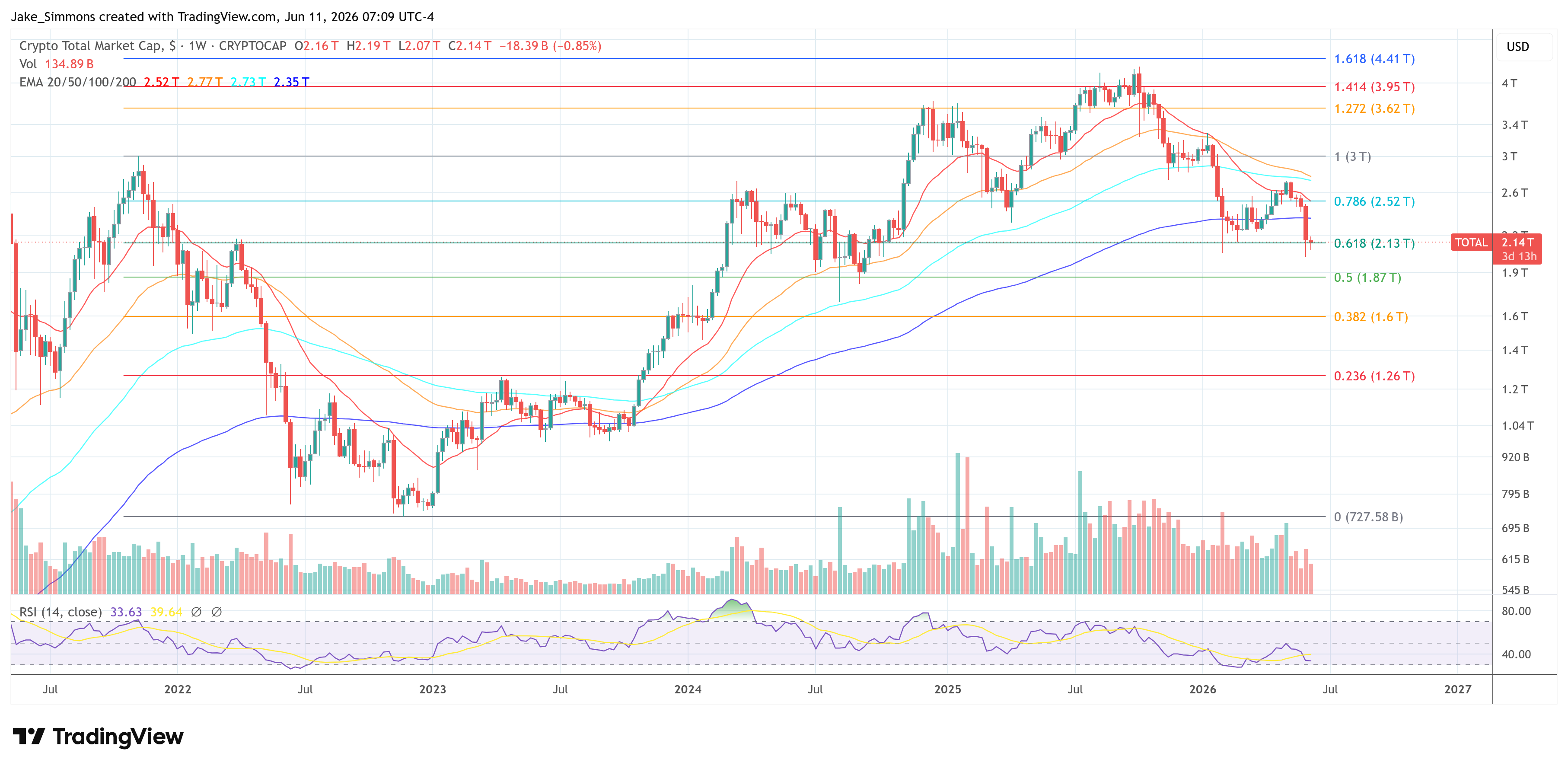
The transaction happened on a day of poor performance for digital currencies. Market capitalization in cryptocurrency fell by approximately 2.1% to $2.25 trillion, while Bitcoin was trading around $63,000, a 2.7% decrease. Ether fell approximately 3.1% down to $1,860 with CryptoQuant estimating the quoted price to be $1,864.85, a 3.56% drop from its value a day before.
Despite the fact that Hayes’s sale was only a small amount of Ethereum’s daily trading volume, it got critical attention as it converted paper losses into realized losses at a time of weak investor sentiment.
A losing streak that started in July
The sale marks the end of a downtrend that started several weeks prior. Based on Lookonchain data, Hayes collected 7,213 ETH between July 15 and July 28 for about $13.87 million, with an average cost of approximately $1,923 per ETH. However, even before Friday’s trade, the position had already been in the red. As Lookonchain stated it’s not surprising, saying Hayes had once again “bought high and sold low.”
Likewise, this contrasts with Hayes’ image of being one of the largest Ethereum long-term optimists. In late 2025, Hayes remarked with confidence:
The coming Ether bull run is about to tear the market a new asshole… Maelstrom is doing all things Ethereum.
Back then, Hayes predicted that ETH would hit the mark of $10,000 by the end of the year.
Since then, however, he has noticeably changed his tone compared to his previous statements. Hayes explained in his article Reality Test:
But right now, it’s about protecting one’s crypto capital.
This statement implies that Friday’s transaction was not so much an exit from Ethereum than a risk-minimizing measure in unpredictable conditions.
The transition is also aligned with Hayes’ overall investing philosophy. Historically, he has made numerous adjustments to his position in response to developments in macroeconomic events, including some high-profile bullish predictions he has made. He has correctly called several major bottom points in the markets, as well as liquidity-driven surges, yet has also accepted when his hypothesis was premature. The importance of the transaction done on Friday resides in its loss, but the readiness to make a change is in line with Hayes’ attitude.
Soft prices and a stretched staking queue
Ethereum still receives conflicting signals. Currently, 41.2 million ETH, which is about 33.8% of the circulating supply, is staked, while the validator activation queue has increased to approximately 43 days, according to data reported by The Block.
Nevertheless, the increasing line of people may not be as optimistic as it looks. Thomas Brunner, the Head of Custody and Staking at Sygnum Bank, informed The Block that most of the activities result from older validators getting their rewards rather than new investors getting into the network.
In addition to its cautious outlook, TD Cowen has recently reduced its end-of-year prediction for the price of Ether to $2,371 from a previous level of around $3,650, as a result of slower-than-anticipated developments concerning the regulations for tokenized assets in the U.S.
In light of that situation, the sale by Hayes has more of a symbolic than a market-impacting value. The trade itself was rather negligible in size that is not enough to influence the price of Ether, but since Hayes is believed to execute trades relying on macro trends rather than on short-term fluctuations, traders understand his moves as insights to the changing corporate risk attitude rather than just another transaction involving a whale.
Don’t just read crypto news. Understand it. Subscribe to our newsletter. It’s free.


Read More