
$2,800 Resistance Still Blocks ETH Despite Bullish Price Structure

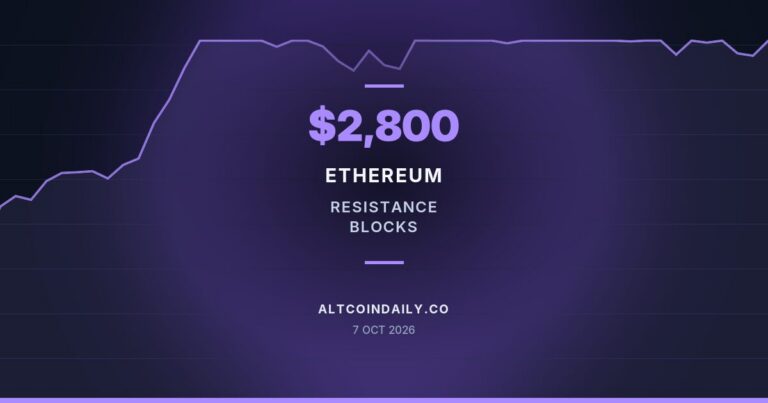


Traders watch for a range breakout as Ethereum consolidates below a key resistance level.
Ethereum continues to trade within a defined range, with market watchers pointing to $2,800 as the level that could determine the next directional move. The broader price structure still favors buyers, according to recent technical commentary, but repeated attempts to clear resistance near that mark have so far failed to produce a sustained breakout.
This pattern is not unusual for crypto assets coming off a period of volatility. After sharp price swings, markets often enter a consolidation phase where buyers and sellers test the same levels repeatedly before a clear trend emerges. For Ethereum, that testing has centered on the $2,800 zone, which multiple analysts have flagged as a pivotal resistance point in recent sessions.
The significance of this level goes beyond a simple round number. Resistance zones like this one often coincide with areas of previous price action, where large clusters of buy and sell orders accumulate. A confirmed breakout above such a zone can trigger further buying as short-term traders and algorithmic systems respond to the shift in momentum. Conversely, repeated rejection at the same level can reinforce it as a ceiling, prompting some traders to reduce exposure or wait for clearer signals.
Market participants are also weighing Ethereum’s position within the broader altcoin landscape. As the largest smart contract platform by market capitalization, ETH’s price action tends to influence sentiment across the wider decentralized finance and layer-2 ecosystem. A sustained move above key resistance could renew confidence in risk assets tied to the network, while prolonged stagnation may keep capital on the sidelines.
The current setup reflects a broader theme in crypto markets this year: price direction increasingly hinges on confirmation through range breaks rather than sharp, sentiment-driven moves. Traders appear to be favoring technical confirmation over speculative positioning, a shift that has made levels like $2,800 more consequential than they might otherwise be.
For now, Ethereum’s structure is described as bullish, meaning the broader trend of higher lows and resilient demand remains intact. But structure alone does not guarantee a breakout. Until the asset closes convincingly above the $2,800 threshold, analysts suggest the range-bound pattern is likely to persist, with traders watching volume and follow-through for signs of the next move.
Market Impact
A confirmed break above $2,800 could draw renewed attention to Ethereum-linked tokens and layer-2 projects, given the network’s central role in decentralized finance. Momentum traders often treat such breakouts as entry signals, which can accelerate price moves once resistance gives way.
If Ethereum instead continues to stall below this level, the consolidation could weigh on sentiment across smaller altcoins that tend to track ETH’s price direction. Market participants are likely to treat the $2,800 level as a near-term reference point for gauging whether bullish momentum can translate into a sustained trend.
Ethereum’s price action remains constructive but unresolved, with $2,800 standing as the clearest marker of whether current bullish structure can translate into a breakout.
Frequently Asked Questions
Why is $2,800 considered a key level for Ethereum?
Analysts have identified $2,800 as a resistance zone where previous price action has repeatedly stalled, making a confirmed break above it a signal of renewed buying momentum.
What does ‘bullish structure’ mean in this context?
It refers to a pattern of higher lows and resilient demand on the price chart, which technical analysts generally interpret as a sign that buyers remain in control of the trend.
What happens if Ethereum fails to break above $2,800?
Analysts suggest the asset could remain in a consolidation range, with price continuing to oscillate between support and resistance until a clearer directional signal emerges.
How might Ethereum’s price action affect other crypto assets?
Because Ethereum underpins much of the decentralized finance and layer-2 ecosystem, its price direction often influences sentiment and capital flows into related tokens and projects.
Original source: AltcoinGordon
Syndicated coverage. Originally reported by altcoingordon.com.




Read More