
AMD Stock Surges 126%, Raising Question: Is Strong AI Growth Still Enough?

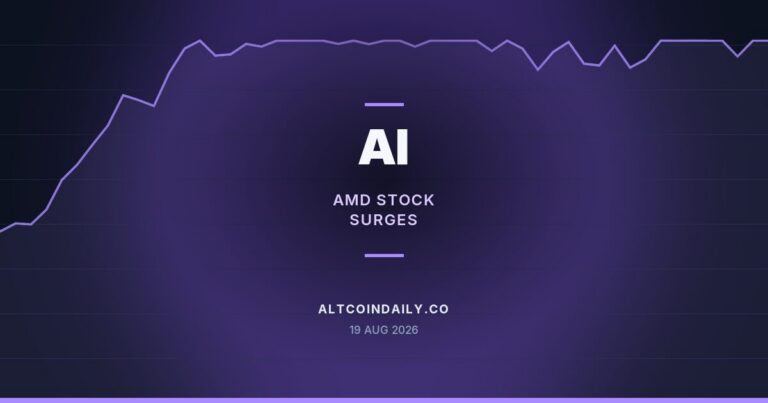


Investors are asking whether AMD’s rally has outpaced what even strong AI earnings can justify.
AMD shares have surged 126%, a rally that reporting from Invezz and Yahoo Finance frames as a turning point for how investors judge the chipmaker. The stock’s climb reflects growing demand for AI-related hardware, a trend that has lifted several semiconductor names over the past year. AMD has been positioned as a key supplier in that buildout, competing for a share of spending tied to data centers and AI infrastructure.
The scale of the increase has changed the conversation around the company. Invezz’s reporting raises the question of whether strong AI-related numbers, once enough to move the stock sharply higher, are now simply expected. When a stock has already priced in significant growth, even solid results can fail to impress if they do not exceed already elevated expectations.
Yahoo Finance’s coverage takes a related angle, describing AMD as having become too important to the AI revolution to overlook. That framing suggests the company’s role has shifted from a growth story to something closer to a bellwether. Investors and analysts increasingly use AMD’s performance as a signal for the health of AI-related capital spending more broadly.
This shift matters because it changes the standard investors apply. Early in a growth narrative, any evidence of AI-driven demand can be treated as a positive surprise. Once a stock has already run up sharply, that same evidence can be read as confirmation of what was already assumed, rather than as new information. The result is a market that requires more from each earnings report or product announcement just to maintain existing valuations.
The broader context here involves the AI infrastructure buildout that has driven much of the semiconductor sector’s performance recently. Chipmakers supplying processors, accelerators, and related components have benefited from heavy spending by cloud providers and large technology companies. AMD’s position within that supply chain has made it one of the names most closely tied to AI capital expenditure trends.
Neither report cited specific price targets or forward guidance figures, focusing instead on the dynamic between rising expectations and stock performance. That distinction is worth noting. The story here is less about a single data point and more about how markets recalibrate the meaning of good news once a stock has already appreciated substantially.
For a company at AMD’s scale, this dynamic is not unusual. Large gains tend to compress the room for further upside unless subsequent results clearly exceed what is already assumed. The reporting suggests AMD has reached that stage, where the market’s attention has shifted from whether AI demand exists to whether it can keep accelerating at the pace already reflected in the share price.
Market Impact
A 126% rally raises the bar for what counts as a positive surprise in AMD’s upcoming earnings and guidance. If future results merely confirm existing AI demand trends without exceeding them, the stock could see muted reactions or pullbacks, even amid genuinely strong performance. This dynamic is common in high-growth technology names once expectations catch up with fundamentals.
More broadly, AMD’s trajectory may serve as a reference point for how markets treat other AI-linked semiconductor stocks. If investors begin demanding acceleration rather than confirmation from AI-exposed companies, volatility could increase around earnings dates across the sector, particularly for firms whose valuations have already priced in substantial future growth.
AMD’s rally illustrates a broader pattern in AI-driven markets, where rising expectations can outpace even strong underlying performance, leaving investors to judge results against an increasingly demanding standard.
Frequently Asked Questions
Why has AMD’s stock risen 126%?
Reporting attributes the gain to strong demand tied to AI-related hardware and AMD’s growing role in AI infrastructure spending, though specific financial figures were not detailed in the coverage.
What does it mean that strong AI numbers are ‘no longer enough’?
It suggests that after such a large rally, investors expect results to exceed already elevated assumptions, not just confirm existing AI demand trends.
Is AMD’s situation unique among semiconductor stocks?
No. Rising expectations after sharp rallies are common across AI-exposed chipmakers, though AMD is highlighted as a particularly closely watched example.
Do the reports include specific earnings or price forecasts?
No. The available reporting focuses on the dynamic between stock performance and investor expectations rather than specific projections.
Original source: AltcoinGordon
Syndicated coverage. Originally reported by altcoingordon.com.





Read More