
Bitcoin ETFs Draw $517M in Biggest Daily Inflow Since May, but Outlets Cite Sharply Different BTC Price Levels

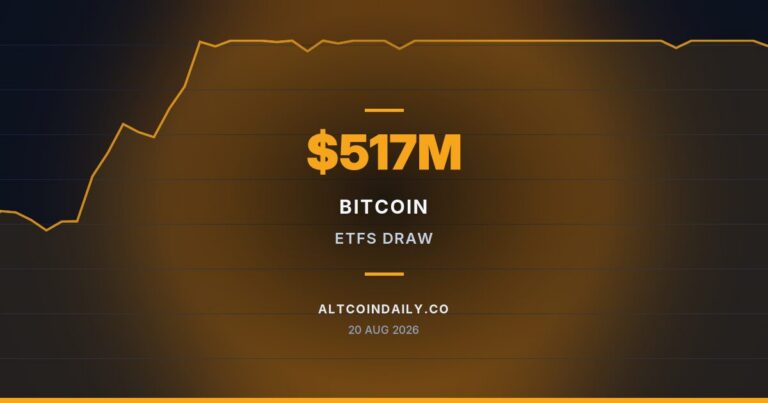


US spot Bitcoin ETFs pulled in $517.2 million in net inflows on Wednesday, their largest single-day haul since May 4, according to Cointelegraph and Crypto Briefing. The Block reported a nearly identical figure, $517.19 million. All three outlets independently confirm both the total and the May 4 comparison, making this the rare data point every source agrees on.
Where the coverage splits is on fund-level detail, macro cause, and — most strikingly — on what Bitcoin’s price actually was, and when.
What the fund flows looked like
The Block, citing its own reporting, said eight of the 12 US spot Bitcoin ETFs posted net inflows on the day. BlackRock’s IBIT led with $284.7 million, according to The Block, followed by Ark & 21Shares’ ARKB at $77.7 million and Fidelity’s FBTC at $62.4 million. Neither Cointelegraph nor Crypto Briefing published a comparable per-fund breakdown for Wednesday specifically, though Crypto Briefing noted that IBIT has, in the outlet’s words, been “accounting for over 70% of daily totals during inflow days” historically, describing Fidelity’s FBTC as playing a supporting role while smaller issuers compete for the remainder.
Cointelegraph, alone among the three, reported that the ETF haul pushed August’s month-to-date net inflows to $1.47 billion, and that the funds had taken in about $1 billion since Monday — the strongest weekly inflow since the week ended January 16, when inflows totaled roughly $1.42 billion. Cointelegraph also reported that spot Ether ETFs logged $189.2 million in net inflows the same day, bringing the week’s Ether ETF total to about $291.5 million.
The Treasury connection
Cointelegraph and The Block both linked the inflow surge to a US Treasury Department decision to expand buybacks of longer-dated government debt. Cointelegraph additionally reported that the rally unfolded alongside a push from President Donald Trump, who at a White House event called on Congress to move the CLARITY Act forward — a sign, in Cointelegraph’s account, of renewed momentum for crypto-specific legislation. Jonatan Randin, senior market analyst at PrimeXBT, told Cointelegraph that the Treasury’s signal pushed yields and the dollar lower, adding: “Bitcoin moved with gold and silver rather than with risk appetite, which is what the debasement trade looks like when it’s working.” That framing and the Randin quote appear only in Cointelegraph’s report.
Where the price accounts differ
This is the discrepancy this review is built to surface — though the underlying ambiguity turns out to be about timing as much as price. Cointelegraph reported Bitcoin traded near $72,000 on Thursday — the day after the $517 million inflow session — up 11% in 24 hours according to CoinGecko, with Ether at $2,286, up 19%. Crypto Briefing, describing the same broader rally, said Bitcoin’s price recovery placed it in the $64,000-to-$65,000 range, but did not tie that figure to a specific date. It is not clear from the evidence available whether Crypto Briefing’s range describes Wednesday’s inflow session, Thursday, or the rally more generally. Neither figure is corroborated in this evidence set by a primary exchange feed, and no outlet reconciles the gap. Readers should treat either standalone price claim with caution until it is checked against exchange-level data and pinned to a specific date.
The bigger pattern
Crypto Briefing placed Wednesday’s total in the context of a longer 2026 trend, reporting that May saw a nine-day consecutive inflow streak totaling approximately $2.7 billion, including a $629 million day on May 1 and the previous single-day record of $532 million on May 4 — the mark Wednesday’s figure nearly matched. Crypto Briefing also reported that daily inflows reached $297.6 million on August 17, followed by $189.3 million the next session, and that the month’s inflow peak had hit $853.5 million as Bitcoin crossed unspecified price thresholds earlier in the year. None of these historical figures appear in Cointelegraph’s or The Block’s reporting.
What’s unresolved
Beyond the price discrepancy, no outlet in this evidence set provides a full list of ETF-level flows beyond the top three funds named by The Block, so the fate of the other five funds that posted inflows — and the four that reportedly did not — remains unreported here. It is also not yet established, based on available reporting, whether Wednesday’s pace continues into a second consecutive strong week or proves a one-day spike tied to the Treasury announcement.
Sources
Every fact above is attributed to one of these reports. Where they disagree, the article says so.
- Crypto Briefing
- Cointelegraph
- The Block (reported; full article not available to us)




Read More