
Dogecoin Spot Flows Swing Sharply Negative as Whales Pull $57M in a Week

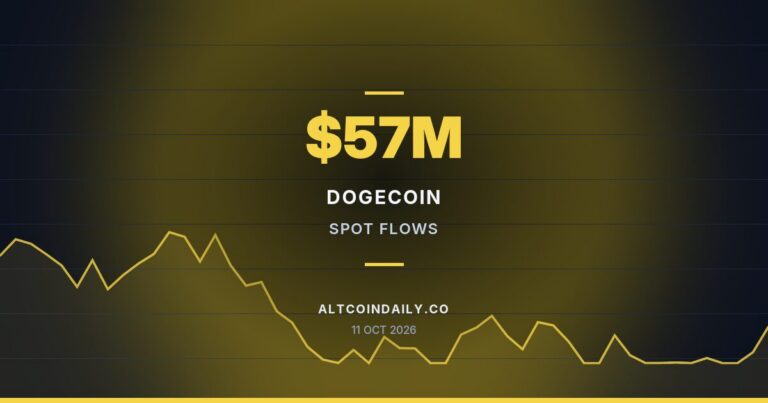


Net outflows signal a shift in positioning among large Dogecoin holders, according to new on-chain data.
Dogecoin’s spot trading flows have turned decisively negative over the past seven days. On-chain data cited by U.Today shows a 599% week-over-week swing in net flows, moving from inflows into substantial outflows. Separately, crypto.news reported net outflows of approximately $57 million over the same period.
Spot flow data tracks the net movement of an asset into or out of trading venues and large wallets. A sharp drop like this typically reflects coordinated selling or repositioning by holders with significant balances, often referred to as whales. When outflows accelerate this quickly, analysts tend to interpret it as a signal that sentiment among large participants has shifted.
The scale of the reversal stands out. A 599% change in a single week is a large move for any flow metric, even in a market known for volatility. It suggests that whatever inflows existed previously were not only erased but replaced by a substantial net outflow trend. That kind of swing often draws attention from traders who use flow data as one input for gauging near-term supply and demand dynamics.
Dogecoin has long been closely watched for whale activity, given its history of large, concentrated holdings relative to other major tokens. Movements by a small number of large wallets can have an outsized effect on short-term price action and trading volume. When those wallets reduce exposure, it can weigh on available liquidity at certain price levels, even without a corresponding change in retail demand.
The reported $57 million in net outflows does not, on its own, indicate the reason behind the shift. Whales may be reallocating capital to other assets, taking profits, or moving holdings to cold storage or different custody arrangements. Each of these actions would register as an outflow from exchange-tracked balances without necessarily reflecting a bearish view on the asset itself.
Market observers often caution against reading too much into a single week of flow data. Flow metrics can be noisy, and short-term swings are common across crypto markets broadly. Still, a move of this magnitude is unusual enough that it has drawn notice from outlets tracking Dogecoin’s on-chain behavior, and it adds to the broader conversation about how large holders are positioning heading into the final quarter of the year.
Market Impact
A sustained reduction in whale-held balances on exchanges can reduce available liquidity for large trades, potentially increasing price sensitivity to new buy or sell orders. If outflows continue, traders may watch for whether reduced exchange supply translates into tighter spreads or more pronounced price swings on lower volume.
Conversely, if the outflows reflect a move toward cold storage rather than active selling, the impact on near-term price action could be limited. Market participants will likely monitor subsequent flow data to see whether the trend reverses, stabilizes, or accelerates further in the coming weeks.
The sharp drop in Dogecoin’s spot flows highlights how quickly whale positioning can shift, even for a token with a well-established holder base. Further data will be needed to clarify whether this marks a short-term adjustment or the start of a longer trend.
Frequently Asked Questions
What does a 599% drop in spot flows mean?
It describes a week-over-week swing in net flow data, moving from net inflows to substantial net outflows. It reflects a change in the direction and scale of capital moving in and out of Dogecoin trading venues.
How much did Dogecoin see in net outflows?
Crypto.news reported net outflows of approximately $57 million over the past week, aligning with the broader flow reversal described by U.Today.
Does this mean whales are selling Dogecoin?
Outflow data shows balances leaving tracked exchange wallets, but it does not confirm the motive. Possible explanations include selling, profit-taking, or transfers to other custody arrangements such as cold storage.
Should investors be concerned about this flow data?
Flow metrics are one of several indicators traders use and can be volatile over short periods. This report does not constitute financial advice, and readers should consider multiple data sources before drawing conclusions.
Original source: AltcoinGordon
Syndicated coverage. Originally reported by altcoingordon.com.





Read More