XRP’s Sharpe Ratio Hits Year-High Level as Price Slips to $1.35

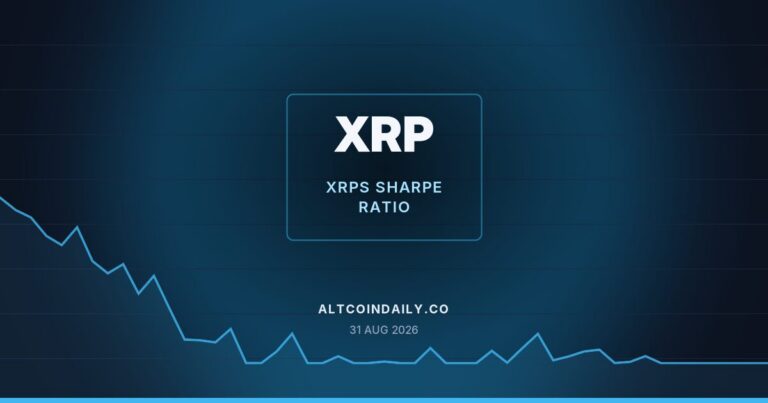


A key risk-adjusted return metric for Ripple’s token has reached a level not seen in twelve months, even as spot prices pull back.
XRP’s Sharpe ratio has moved to a level not seen in a full year, according to a report from CryptoPotato. The Sharpe ratio is a standard tool in traditional finance and crypto analytics. It measures returns generated relative to the volatility, or risk, taken to achieve them. A rising Sharpe ratio generally signals that an asset is delivering more consistent, risk-adjusted performance rather than simply moving on speculative swings.
The development arrives even as XRP’s spot price has softened. AMBCrypto reported the token fell to $1.35, prompting traders to focus on a specific support zone. That zone is being watched as a potential decision point for buyers looking to enter or add to positions during the pullback.
The combination of a stronger Sharpe reading alongside a price dip may seem contradictory at first glance. But the two data points describe different things. Price reflects where the market values the asset right now. The Sharpe ratio reflects how efficiently that price has moved over a defined window, accounting for volatility along the way. A token can see its Sharpe ratio improve even during a correction, if the broader trend of returns relative to risk has been strengthening over time.
For XRP specifically, the past year has included periods of sharp rallies and equally sharp retracements. Traders often cite the token’s volatility as both an opportunity and a risk. An improving Sharpe ratio suggests that, measured over the recent period, XRP’s return profile has become more favorable relative to its swings. That can matter to institutional allocators and fund managers who use such metrics to size positions or compare assets across a portfolio.
At the same time, the pullback to $1.35 keeps near-term attention on support levels. AMBCrypto’s coverage pointed to a specific price zone as the next test for dip buyers. Whether that zone holds could determine if the recent bounce attempts continue or if selling pressure extends further. Support and resistance zones are widely used by traders to gauge where buying or selling interest may cluster.
Neither report included forward price targets or guarantees about direction. Both outlets framed the current picture as a snapshot of technical and statistical indicators rather than a forecast. Readers should treat the Sharpe ratio milestone and the price action as separate but related signals worth monitoring together, rather than as a single directional call on XRP’s next move.
Market Impact
An improving Sharpe ratio can influence how institutional desks and quantitative funds view XRP within a broader portfolio, since it speaks to risk-adjusted efficiency rather than raw price momentum. If the trend holds, it could support continued interest from allocators who weigh volatility alongside returns before committing capital.
The price dip to $1.35, however, keeps short-term trading focused on technical support. Whether that level holds will likely shape sentiment among retail traders in the days ahead. A failure to hold support could offset some of the positive signal from the Sharpe ratio data, while a bounce could reinforce it.
The divergence between XRP’s improving risk-adjusted performance and its near-term price weakness underscores how different metrics can tell different parts of the same story. Traders will likely watch both the support zone highlighted by AMBCrypto and any follow-through in the Sharpe ratio trend flagged by CryptoPotato for further confirmation.
Frequently Asked Questions
What is a Sharpe ratio and why does it matter for XRP?
The Sharpe ratio measures how much return an asset generates relative to the risk, or volatility, involved in achieving it. A higher ratio suggests more efficient, risk-adjusted performance, which can matter to traders and fund managers assessing XRP alongside other assets.
Why did XRP’s price fall to $1.35?
AMBCrypto reported the drop as part of broader market price action but did not attribute it to a single specific cause. The report focused on the support zone traders should watch next rather than the reasons behind the decline.
Does a rising Sharpe ratio mean XRP’s price will go up?
No. The Sharpe ratio reflects historical risk-adjusted returns, not a forecast of future price direction. It is one data point among several that traders use to assess an asset’s performance profile.
What should dip buyers watch for after the drop to $1.35?
According to AMBCrypto, traders are focused on a specific support zone below current levels. Whether that zone holds could influence whether buying interest returns or selling pressure continues.
Original source: AltcoinGordon
Syndicated coverage. Originally reported by altcoingordon.com.


Read More