Inside TrumpVsMusk.fun: The Blockchain War Game Where Every Trade Fires a Shot



Somewhere on a server in Germany, two cartoon armies have been shooting at each other for forty-six hours without a break, and neither of them is ever going to win. That is not a bug. It is the entire product.
TrumpVsMusk.fun is a free browser game in which two memecoins fight a 3D war. Red is $TRUMP. Blue is $MUSK. Every real buy and sell on the chain fires a real shot on the battlefield, and the front line physically moves toward whichever side has the momentum. There is no round, no reset, no final score. You open a tab and there is already a battle happening.
It is one of the more genuinely inventive things built on a memecoin this year — and it is also, right now, a pair of tokens with a combined market capitalisation of about eight and a half thousand dollars. Both of those sentences are true at once, and this article covers both.
What it actually is
Open the site and you get a 3D battlefield rendered in your browser. Two armies. Tanks, infantry, artillery, bombing runs, weather, day and night. No install, no sign-up, no wallet, no account. Most people who look at it will never buy either coin, and that is fine — watching is free and the project treats spectators as the main audience rather than a funnel.
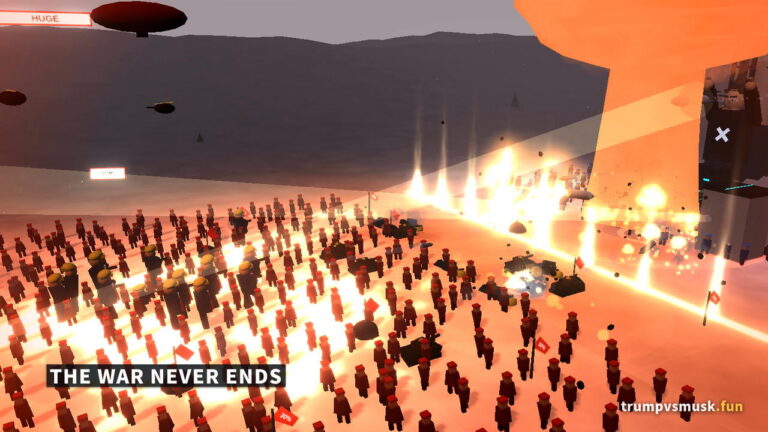
The fighting is not a video and it is not on a loop. It is a simulation wired directly to on-chain trade events. When an order lands, a soldier fires. Bigger order, bigger explosion. A very big one shakes the camera and scatters the infantry.
The latency is the part worth appreciating. Blocks on the underlying chain come roughly every 100 milliseconds; the game polls every 1.2 seconds and waits two confirmations, which puts a buy on the battlefield about a second and a half after it lands. You can, in practice, place an order and watch your own money explode.
The five rules that run the whole thing
The mechanics are deliberately small enough to hold in your head:
- Every trade is a bullet. A small buy is a rifle tracer. A large one is artillery.
- Price is attack power. A side with momentum hits harder — same number of shots, bigger holes.
- Growth is territory. Ground follows market-cap growth, never absolute size. This is the single smartest design decision in the game, and it is worth explaining properly.
- The front line never resets. Ground taken stays taken until the other side takes it back.
- One holder is one warrior. Every wallet holding a coin is drawn as one figure standing behind its line.
On that third rule: if territory tracked raw market cap, the bigger coin would simply own the map forever and the war would be over on day one. So every metric is relative and measured over a rolling window. A $300M army that is growing takes ground from an $800M army that is flat. The line is also soft-capped, so neither side can ever be shoved off the map entirely — there is always a comeback available. Battle power is composed of trading volume, price performance and market-cap growth, and nothing else on the site can move it. Not enlisting. Not recruiting. Only trades.
The bit nobody expects: the armies build cities
Here is where the project stops being a chart visualiser and starts being a game.
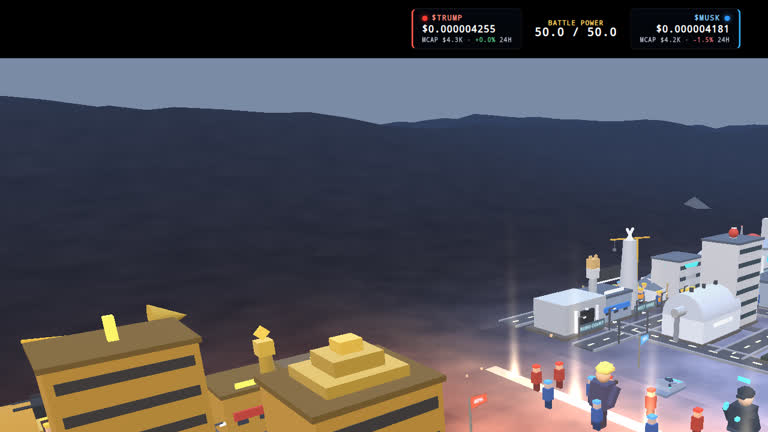
When the chart goes quiet — specifically, after two minutes with no eligible trade — the war does not pause. It changes jobs. Work brigades peel off the front line and start building. Roads first, then lighting and infrastructure, then buildings, following a master plan of roughly a hundred structures per side. Cranes go up. Cars appear on the finished roads. The moment a trade lands, everyone drops their tools and sprints back to the fight.
Nothing appears from nowhere. Every structure on that map was put up on camera, in real time, during a quiet stretch, on the broadcast.
The financing is where it gets funny. Each city is paid for out of its founder’s real, sourced, dated net worth — Trump’s from Forbes in March 2026, Musk’s from Forbes in June 2026. The two cities cost exactly the same to build. One founder can comfortably afford that and the other cannot. So one treasury goes publicly, permanently negative and keeps building anyway, and a debt clock ticks up on screen while the other boss mocks him for it. A roughly 150× wealth gap buys you no construction speed at all — only solvency. That asymmetry is the joke, and it is the best joke in the product.
Because real trading volume and real net worth are seven orders of magnitude apart, the game applies one conversion: $1 of real on-chain volume becomes $1,000,000 of city capital. That rate is printed on the site and the true, unconverted trading figures are always displayed separately, which is the correct way to do it and rarer than it should be.
Attacks are real too. A large enough buy scars the far side’s building nearest the front line — front row falls first, deeper rows only once the row ahead is rubble. Roads and infrastructure are immune. Repairs jump the construction queue. A building damaged past 85% collapses into actual rubble and smoke and stays that way until somebody rebuilds it.
Two cartoons who will not shut up
Each army has a boss standing behind it — parody caricatures, not the real people, and the site says so about six times. They are not decoration. They react to what is actually happening on the chart: a whale buying, the lead changing hands, a long dead stretch, a collapse, their own city taking a hit.
By the site’s own count they have 778 written lines between them, plus scripted exchanges where one sets up a joke and the other is guaranteed to land the punchline about three seconds later. The line picker always chooses whatever has gone unheard the longest and remembers across visits, so coming back tomorrow does not restart the same handful of gags. They are voiced, not robotic — the audio is generated through a character-voice pipeline with a pre-rendered clip library behind it.
They also both know the US midterms land on Tuesday 3 November 2026, and they bring it up more as it approaches. After it passes, they stop, because nothing here should still be counting down to a date that has already happened.
One editorial rule sits over all of it: when a line refers to something that actually happened — a court ruling, a donation, a department closing — the underlying fact is checked before it ships. It is a parody, so it is allowed to be unfair. It is not allowed to be wrong.
You can put your own name on the field, for free
Press ENLIST, type a name between two and sixteen characters, pick an army. That is the entire form. No wallet prompt, no email, no password, no account.
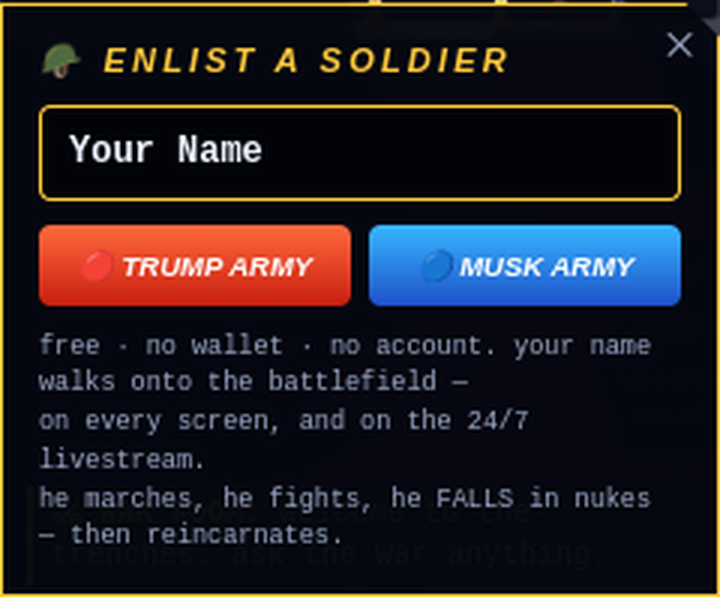
You get a soldier carrying your name who marches, fights, dies in the big moments and comes back — and a permanent link like trumpvsmusk.fun/s/AB12CD that is the entire account system. Post the link anywhere and the preview carries your soldier’s name rather than a generic site card. Follow someone’s link and the camera goes and finds that specific soldier, marks him gold for about nine seconds, then hands control back. If he is not on the field, the war feed says so rather than pointing at a stranger and pretending.
Recruit five people through your link and your soldier becomes a tank with your name on it. Recruit twenty and the announcer reads your name out over the battlefield.
Crucially: ranks never touch battle power. Recruiting cannot move the war in your side’s favour, by design. The moment it could, every number on the scoreboard would be worth less.
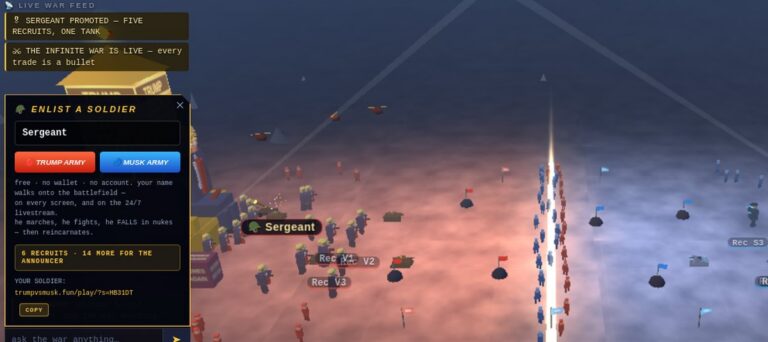
What is stored about you: the name you chose, the army you picked, the date, and your soldier’s code. That is the whole record. No email, no wallet address, and your IP is never written to disk — it is held in memory to rate-limit enlistments and then discarded.
The tokens, and the contract addresses
Both coins launched on PONS (ponsfamily.com), a launchpad on Robinhood Chain (chain ID 4663). Both are paired against ETH. Both have a fixed supply of one billion tokens with 18 decimals, and both carry a 0.00% creator tax. We verified the name, symbol, decimals and total supply of each contract by calling it directly on the chain rather than taking the website’s word for it.
$TRUMP — “TRUMP ARMY”
0x2a1Ea2A208FDbb4407b3610CF2f87CFB39BddA4e
$MUSK — “MUSK ARMY”
0x02Da723b03A0CAdd55ea47530817cF7971810787
Check these against trumpvsmusk.fun itself before you do anything with them. That is not boilerplate — it is the single most useful habit in this entire corner of the market. The project publishes its addresses in exactly two places, its own site and its pinned post on X, and states plainly that it never DMs first and never asks anyone to connect a wallet to claim anything. Treat any third source, including this one, as something to verify rather than trust.
Both tokens are still on their bonding curve. PONS closes the curve at 4.2 ETH raised, at which point liquidity moves into a Uniswap pool. As of 15 August 2026, $TRUMP had raised 0.2736 ETH — about 7% of the way — and $MUSK 0.2542 ETH, about 6%.
The honest numbers
This is the part a promotional post would leave out. Every figure below was read from the game’s own chain indexer at 19:41 UTC on 15 August 2026:
| $TRUMP | $MUSK | |
|---|---|---|
| Market cap | $4,255 | $4,181 |
| Price | $0.00000425 | $0.00000418 |
| Holders | 15 | 17 |
| 24h volume | $0 | $54.79 |
| Battle power | 50.0 | 50.0 |
$TRUMP has recorded 598 trades since launch — 295 buys against 303 sells.
Fifteen and seventeen holders. Fifty-four dollars of volume across a day. A dead-even scoreboard because there is barely enough trading to tilt it. The public recruit roster is, at the time of writing, empty.
So: the engineering is a long way ahead of the market. A 24/7 broadcast, a hundred-building construction system, a comedy writing room and a sub-two-second on-chain event pipeline are all pointed at two tokens that a single four-figure order would move by a multiple. If you take nothing else from this article, take that sentence.
It is broadcasting right now
The same battlefield streams around the clock to @TrumpVsMuskFun on X — rendered on a dedicated GPU box that never closes the tab, so the war continues whether or not anyone has the site open. At the time of writing it had been on air continuously for 46 hours.
There is also a data-honesty rule worth flagging, because it is unusual. If the live feed drops, a badge appears and every number freezes at its last real value. The battlefield does not invent movement to fill the gap. A war that moves for fake reasons is a screensaver, and the project seems to understand that its whole premise collapses without that rule.
What is coming
The published roadmap is unusual in that it promises nothing about price and only commits to things that either exist or can be shipped: daily battle reports, automatic share cards when the battlefield does something notable, a weekly leaderboard for the wallets firing the most ordnance, an all-time records board, mobile polish, an OBS-ready stream layout, and a war chat that talks back using what is actually on the map.
The fixed point is 3 November 2026, when the US midterms will make these two names the loudest words on the internet for twenty-four hours, and the plan is an all-day broadcast at maximum volume. The site is careful to add that it has no predictions and no opinions about anything happening off the map — and that on 4 November the war is still running, because it never had anywhere to stop.
The risks, stated plainly
None of this is investment advice, and the following is the part to read twice.
- These are nano-cap tokens. Roughly $4,200 each, with fifteen to seventeen holders apiece. Liquidity at that size is nearly theoretical; a single ordinary-sized order moves the price by multiples in either direction, and exiting is not guaranteed to be possible at any particular price.
- They are pre-graduation. Until 4.2 ETH is raised, the bonding curve is the market. There is no deep pool underneath.
- It is a memecoin, and the project says so. There is no revenue, no yield, no utility claim and no promise of one. The tokens exist to drive a cartoon.
- It is unaffiliated parody. The armies are cartoon characters and the project is not connected to, endorsed by or sponsored by any real person or company. Parody around living public figures carries its own risk of complaint regardless of merit.
- Verify the contract address before every single interaction, from the project’s own site. Impersonation of small tokens is close to automated at this point.
The honest summary: TrumpVsMusk.fun is a genuinely creative piece of software with a much better game inside it than its market cap implies, and the correct way to enjoy it costs nothing at all. Watching is free. Enlisting is free. Neither requires a wallet, and the project has gone out of its way to make sure neither one moves the scoreboard.
Everything else is a $4,000 memecoin. Size your curiosity accordingly.
More original reporting from our desk is collected on the AltcoinDaily Originals page.


Read More