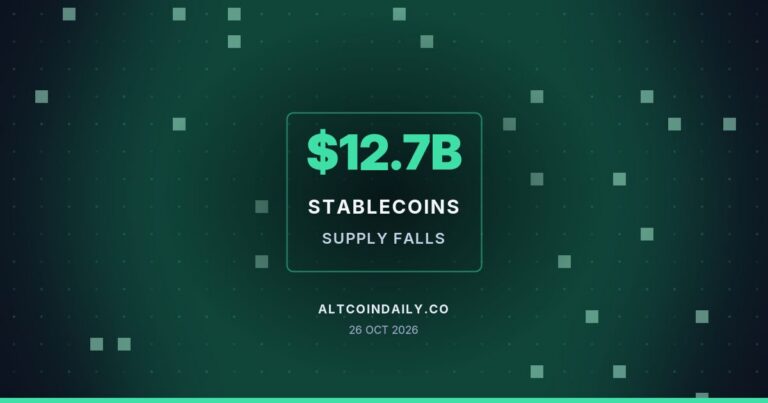
Stablecoin Supply Falls $12.7 Billion as Crypto Market’s Cash Reserves Shrink



USDC accounted for most of the monthly decline, raising questions about available trading liquidity.
The combined market value of major stablecoins fell by $12.7 billion over the past month, according to Bitcoin.com News. The decline touches a metric traders watch closely as a gauge of liquidity sitting on the sidelines of crypto markets.
Stablecoins function as dollar-pegged tokens used to move value between exchanges without converting back to fiat currency. Traders often park funds in stablecoins between trades. A shrinking supply can signal that capital is leaving the crypto ecosystem entirely, rather than simply rotating between assets.
Cryptopolitan reported that USDC, issued by Circle, accounted for the largest share of the drop. The outlet put USDC’s loss at $4.69 billion for the month, making it the primary driver of the broader decline. That figure represents a substantial portion of the total $12.7 billion contraction across the stablecoin sector.
The phrase “dry powder” is commonly used in finance to describe capital held in reserve, ready for deployment when opportunities arise. In crypto markets, stablecoin balances held on exchanges are frequently cited as a rough measure of this reserve capital. A decline in that balance suggests fewer resources are immediately available to absorb selling pressure or fund new buying activity.
Stablecoins like USDC are typically backed by cash and short-term government securities held by the issuer. When users redeem tokens for dollars, the issuer burns the corresponding supply, shrinking the circulating total. A large redemption wave, like the one apparently behind USDC’s drop, can reflect investors moving funds out of crypto markets and back into traditional finance.
The stablecoin sector has grown into one of the most closely watched corners of digital assets. Regulators in the United States and elsewhere have increased scrutiny of issuers over reserve composition and redemption practices. Movements in supply, particularly sudden drops concentrated in a single issuer, tend to draw attention from both traders and policymakers tracking systemic risk.
Market Impact
A sustained drop in stablecoin supply can weigh on trading volumes and reduce the capital available to support asset prices during periods of volatility. If the decline reflects investors exiting crypto markets rather than shifting between tokens, it could point to reduced near-term buying capacity across exchanges.
Because USDC represents a large share of the overall decline, its redemption activity will likely remain a focal point for market watchers assessing broader liquidity conditions. Traders and analysts often use stablecoin supply trends alongside exchange balances to gauge whether capital is entering or leaving the digital asset ecosystem.
The $12.7 billion stablecoin contraction, led largely by USDC redemptions, underscores how closely tied crypto liquidity is to stablecoin supply trends. Market participants will likely continue monitoring these figures for signs of whether capital is returning or continuing to exit.
Frequently Asked Questions
What does a decline in stablecoin supply mean for crypto markets?
A shrinking stablecoin supply often indicates reduced liquidity available for trading. It can suggest investors are converting holdings back to fiat currency rather than keeping funds within crypto markets.
Why did USDC account for most of the decline?
Cryptopolitan reported that USDC lost $4.69 billion over the month, the largest single component of the broader $12.7 billion stablecoin market decline, though the report did not detail the specific cause of the redemptions.
What is meant by crypto’s ‘dry powder’?
The term refers to capital, often held in stablecoins, that sits ready to be deployed into crypto assets. A decline in this reserve can signal reduced near-term buying capacity in the market.
How are stablecoins like USDC backed?
USDC and similar stablecoins are generally backed by cash and short-term government securities held by the issuer, which are used to redeem tokens for dollars on demand.
Original source: AltcoinGordon
Syndicated coverage. Originally reported by altcoingordon.com.




Read More